

In less than three months, Carleton University’s graduating class of 2026 will walk across a stage pitched in the university’s Fieldhouse, shake hands with a faculty member and walk away with an undergraduate degree.
This year’s graduating class is unique: It is the first to complete an entire four-year degree with Large Language Models (LLMs) available at the touch of the student’s fingertips. LLMs are a type of artificial intelligence first released by OpenAI on Nov. 30, 2022, which for many graduating students, marked their first-ever semester of university.
The tool was an instant global hit and has permeated through all sectors, including education. In the four years since its launch, universities have been trying to contend with how AI is restructuring education.
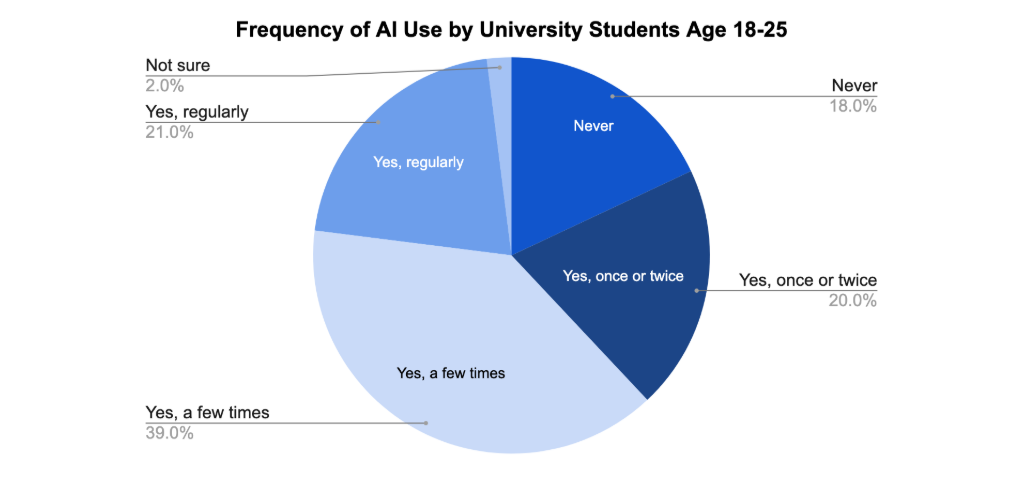
A 2025 report by online learning platform Studiosity and YouGov found that 80 per cent of university students aged 18-25 use AI to help with academic tasks.
However, more than half of the students who reported AI use said they were less confident they are learning new skills or improving pre-existing ones while using AI.
Carleton leaves it up to professors to decide how their students use the tool.
Some outright forbid it. Others require it. Most fall somewhere in the middle.
Students graduating this year are feeling the uncertainty stemming from how the technology is revolutionizing their university degree.
AI can be “more harmful than helpful” in learning
For Ben Mostafa, a Carleton student in his final year of software engineering, using AI in his first two years of school would have been “more harmful than helpful.”
The chatbot “would get wrong code, wrong answers, all the time,” he said.
Mostafa said AI would give him tips, tricks and shortcuts for solving a math problem, but that didn’t prepare him for an exam where he had to solve 20 questions in an hour.
Even though Mostafa is hesitant to acknowledge the benefits of AI, he still uses it and pays for a subscription to ChatGPT Plus.
He said he must because the amount of work his professors give him has increased since the introduction of AI.
Some of his professors have told him they “set up the assignments, tests and quizzes with the understanding that most students are going to be using AI,” he said.
“I feel like I’m being forced into using AI because if I don’t, I’m going to (fall) behind. It isn’t really manageable without it.”
AI “encouraged” for students
Mostafa is not the only student who says using AI feels like a necessity.
Adam Saunders did not use AI for the first two years of his aerospace engineering degree, either.
“You’re spending all this money to be in university, just to get AI to do the work for you,” the fifth-year student said.
But after returning to Carleton after a 16-month co-op stint in September 2025, he said he felt a major change in the professor’s approach to AI use.
Professors went from an outright ban on the use of AI to allowing it to help students study, proofread texts and even assignments where Co-Pilot would be the one completing tasks, he said.
“Dang, they’re actually encouraging this,” he recalls thinking.
In one sustainable engineering class, Saunders said the professor had students make AI doppelgangers of themselves and submit assignments from the AI agent’s profile.
Now, Saunders said he has warmed up to the technology. He has used AI to study concepts for a niche upper-year course, write cover letters and resumes and identify theoretical gaps in research.
While he sees value in the technology, he doesn’t think the university should be strongly encouraging it.
“You’re being paid to teach me,” Saunders said. “I would not want a professor to say, ‘Oh, yeah, just go ask AI about this.’”
AI as a tool, “not competition”
As AI becomes more commonplace in jobs, Mohamed Al Guindy, a Carleton business professor studying technology and the economy, encourages students to look at AI as a tool, not as competition.
Students should be able “to utilize (these tools) to help themselves and to advance their own skills,” Al Guindy said, such as cutting programming time with the help of AI.
He said becoming familiar with AI will become important when the technology fully realizes itself in the workplace.
Nonetheless, the professor stressed the importance of students understanding the foundational concepts of a topic before turning to AI.
“You can make AI work for you, but you need to know what you’re doing to make it work for you,” he added.
Carleton’s policy on AI use
Carleton released its official AI framework on March 27, 2026, four years after ChatGPT was made public.
Initially, the university’s draft framework said it must act to promote “critical AI literacy within our community.”
Following a five month consultation process with students and staff, the university shifted away from AI friendly rhetoric, including “striving to integrate at least one AI-related topic or activity in each course,” to a more hesitant approach.
The most recent framework reflects concerns about the negative possibilities of AI in areas such as labour, workloads and the environment. However, it also acknowledges the potential for AI to “support effective teaching practices, deepen learning experiences, foster innovation.”
Ultimately, the framework gives each professor the freedom to decide how AI is used in their classrooms.
Simon Viel, a physics professor at Carleton and faculty senator, agrees that AI literacy is “extremely” important. He said he uses AI in his research to train neural networks for physics experiments.
But in his personal opinion, teaching skills like critical thinking, human judgement and ethics cannot be outsourced to AI, Viel said.

He gave the example of reading, writing and arithmetic still taught in elementary school, even though text-to-speech devices exist. The need to develop skills, even if a technology can do them, applies all the same to university education, Viel said.
Students should first be equipped with university-level knowledge and skills before learning how AI can benefit their work, he said.
Viel is still trying to understand how to use AI effectively in the classroom “without sacrificing those key learning objectives.”
Saunders said an AI-free first half of his undergraduate years helped him grasp foundational engineering concepts. But AI is much more commonplace now than it was even a couple years ago.
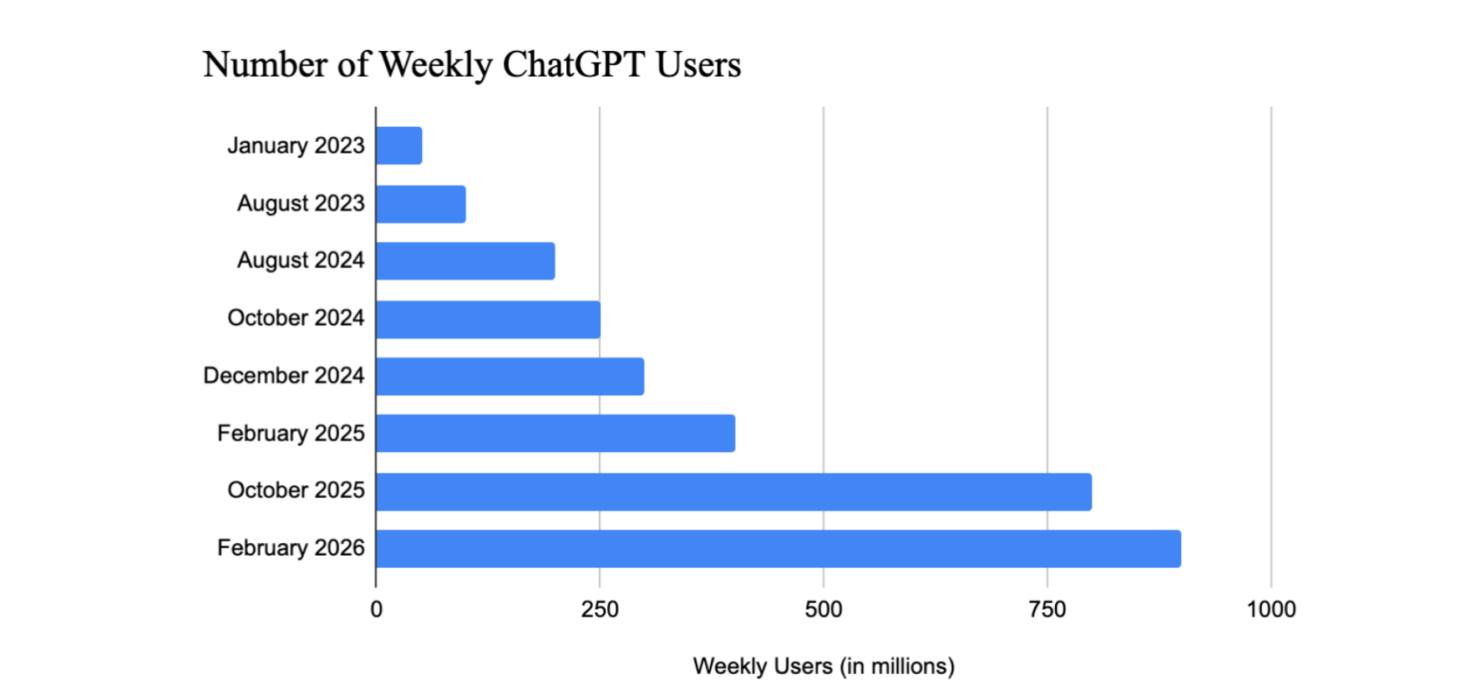
ChatGPT’s weekly active users grew from 50 million in January 2023 to 900 million in February 2026, according to data compiled by DemandSage.
Saunders said easily available AI calls for more responsibility on students to know how to use AI to encourage learning and not just generate answers.
“If you are a first-year engineering student right now and you are using AI to do parts of your assignments and then going to finals and just getting a 51 per cent, you’re cooked,” he said.
Changing the approach to education
Just with any technological revolution, new approaches bring to light fundamental questions about the future of evaluations and higher education as a whole.
“On the instructor’s side, a lot of conversation is happening,” Viel said.
In the popular and large PSYC 1001 class held in the fall term, Carleton professor Lindsay Richardson changed her approach to grading. She made weekly quizzes, worth 8 per cent of a student’s mark, open-book, available all semester, pass or fail, with unlimited attempts.
Richardson said it would take the same time to just attempt the questions as using AI.
In the current model of education, grades are the incentive to learn, which is a problem, Richardson said.
“Students need to feel like there’s intrinsic value in what they’re doing.”
AI is giving students a way to cope with the pressure of maintaining high grades by offloading their work when things become hard with a few keyboard clicks.
“There’s a very easy way to avoid failure,” she said, but encourages students to try. “Hand me in something s—y … write something that’s not great and then you’ll get feedback,” she said.
In a world where a student can find sidesteps to learning, Richardson said, “It’s about reminding (students) that learning is difficult, but that you need to sit with it.”
A changing workforce
This year’s graduating class may leave universities behind, but the evolving conversations around AI ethics will follow them into the workforce.
According to a 2024 Statistics Canada study, AI could change the job for 60 per cent of employees in Canada. The study suggests that for about half of those affected, AI would complement, rather than replace, the work of these individuals.
Mostafa watched this first-hand in his co-op placement through Carleton back in 2024. During his eight-months at a software engineering company, he used Co-Pilot to write many of his code.
“It was impossible to meet the deadlines with it,” Mostafa said. “All I was doing was telling AI about errors and asking for help,” he said. “I was more of an advisor to the AI rather than it advising me.”
But this has been taxing in its own right for Mostafa, who just “really likes computers.”
“I fix computers in my free time; it is something that I really enjoy. To see it transfer to: ‘Get this done as soon as you can,’ it hurts,” he said.
Difficulty breaking in
Now entering the workforce, Mostafa is finding a lack of entry-level positions in his job search, partly, he suspects, due to companies having AI complete those jobs.
“Here I sit six years after a degree that I am very passionate about left with two options. Either start something of my own or go into the trades,” he said.
Saunders is about to start a master’s at Carleton, purely to wait out the harsh job market.
He said he is frustrated that students who used AI to complete school projects can “just pass it off as if they actually did the work” on resumes and cover letters.
“The only place you can really prove (what you know) is an interview. But of course, it’s hard to get to the interview when everyone has the same resume.”
Featured image by Miriam Visser/the Charlatan.