

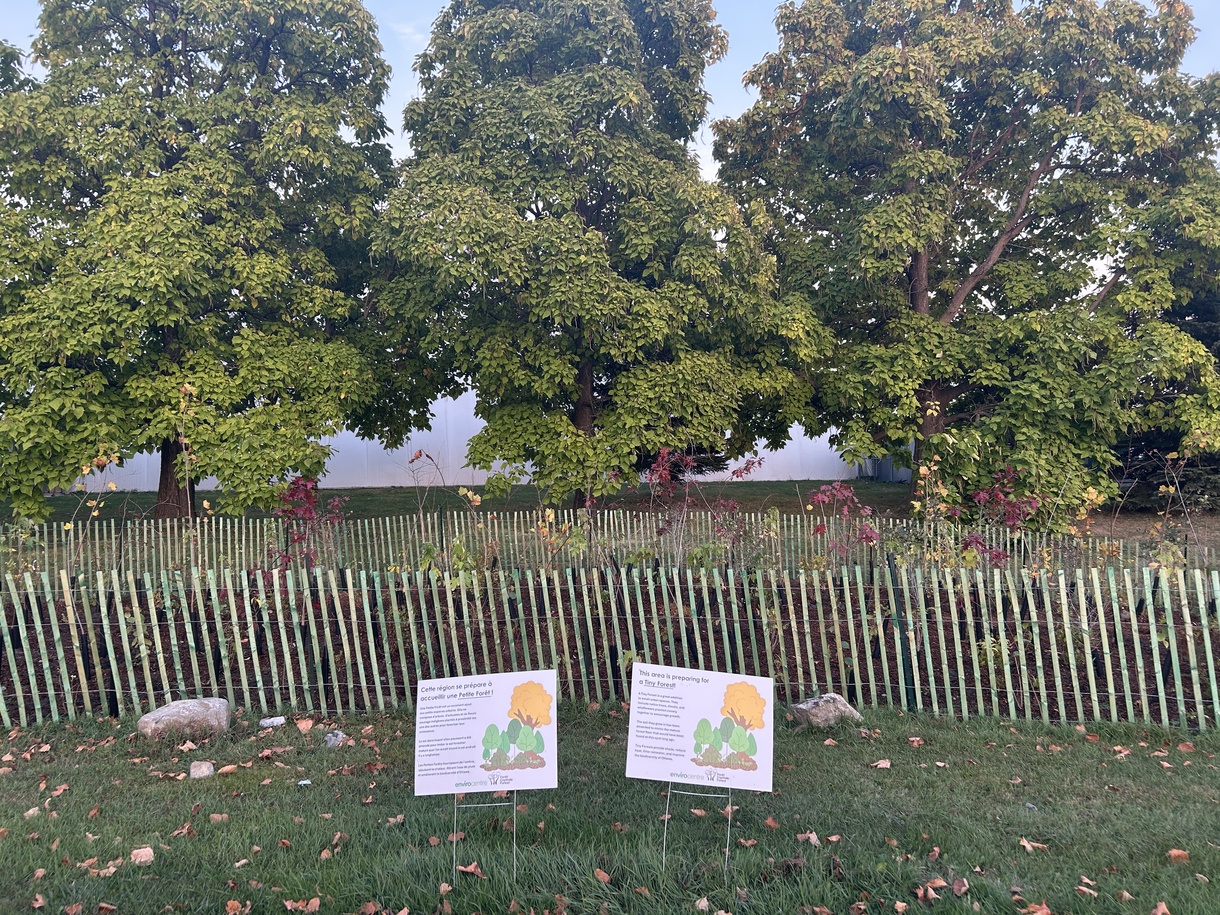
Carleton University’s campus is getting a “tiny forest” filled with native plants to support local ecosystems.
The project is being implemented in partnership with EnviroCentre, a local non-profit organization focused on designing solutions to reduce carbon emissions. The green space is coming to the tennis courts along University Drive.
A tiny forest is a small-scale and densely planted group of native plants that can include trees and shrubs, the university said in a statement.
The forest will be planted using the Miyawaki method, a technique designed to speed up forest growth.
“The Miyawaki method starts with preparing the soil to return it to the state that it would have been in when it was a nutrient-rich, healthy forest floor many years ago,” said Andrea Flowers, director of community sustainability programs at EnviroCentre.
The three-layer forest will feature a variety of vegetation, including cedar and spruce trees.
“A tiny forest can help us build resiliency to climate change,” Flowers said.
“The planting is done in a very dense way, which helps accelerate growth and mimic a mature natural forest floor.”
EnviroCentre has planted other tiny forests across the city, including in the Sandy Hill and Lower Town neighbourhoods.
“This isn’t in isolation. Carleton is part of a broader program of tiny forests in the community,” said Carleton sustainability manager Philip Mansfield.
Mansfield added the total cost of the project is around $20,000.
The university said it received funding from sources including the city, Trees for Life and the Josette Robertson and Joan Johnston Family Foundation.
Mansfield said the green space could also serve as a “living lab” for research and educational use in the future.
The new green space could also provide mental health benefits for people on campus, according to a Carleton expert.
“Nature seems to restore our attention, help us think more clearly, and support problem-solving and creativity,” said John Zelenski, a psychology professor studying the link between nature and happiness.
Planting for the tiny forest happened this weekend.
Featured image by Michael McBean/the Charlatan