

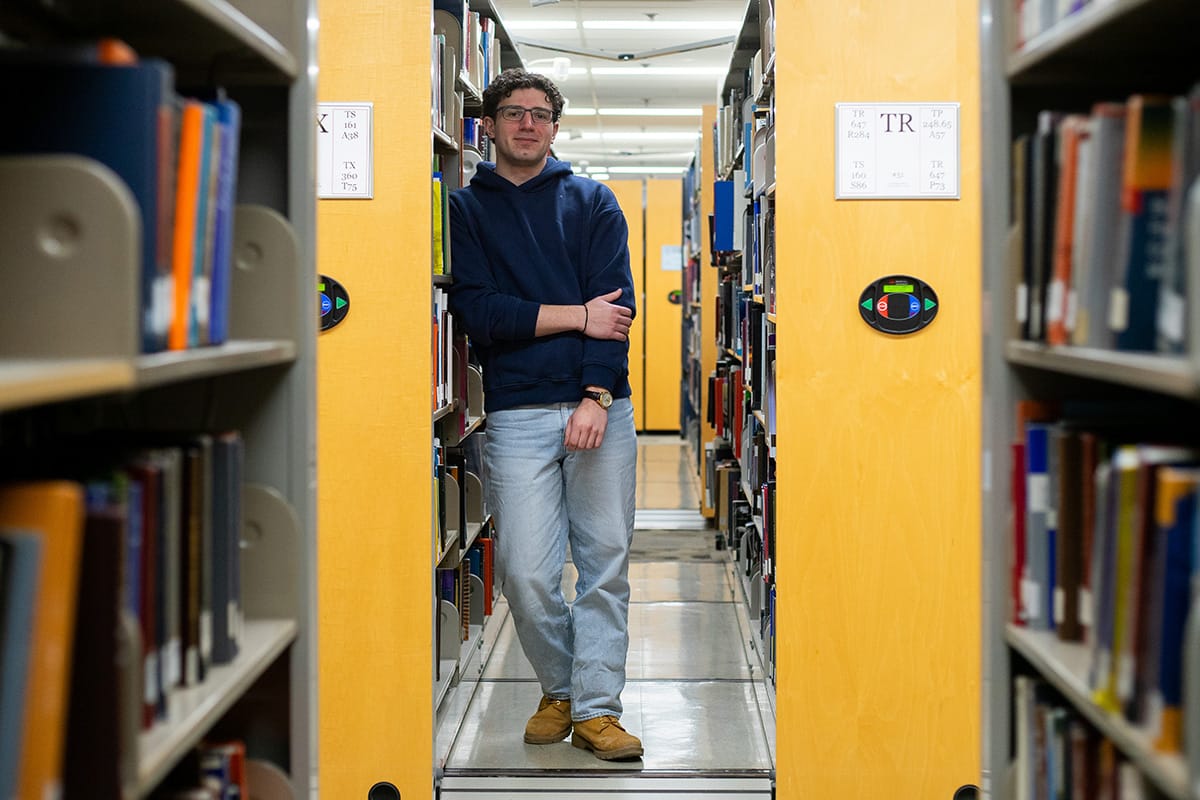
In George Andreopolous’s first week at Carleton University, he wanted to match the accommodations he received from his Individualized Education Program in high school.
He reached out to the Paul Menton Centre, the campus disability services department, and chose extended exam time and a smaller exam room, plus access to the volunteer notetaker peer-based support program.
Volunteer notetakers attend their own lectures, take notes and anonymously submit to an online portal within 72 hours of the lecture for PMC students to access.
Andreopolous, a third-year computer science engineering student, said he enjoys all of his accommodations — but can’t rely on the volunteer notetaker program.
He said the notes are often incomplete, with some notetakers quitting mid-semester or not even signing up at all.
“I tried relying on the one for a class in year one, and my grade wasn’t good,” he said. “When I transitioned off of the lecture notes that were posted by PMC, and I went to my friends, my grades improved quite a lot.”
Because volunteer note-taking is a volunteer service, not an approved accommodation, quality notes – or notes at all – are not guaranteed. The PMC states on their website that the volunteer’s notes are “not intended to substitute” the PMC student’s notes and should serve as a supplementary resource.
But the anonymity of the program allows students to submit incomplete or empty notes, and therefore avoid accountability, Andreopolous said.
Finding — and keeping — notetakers
Volunteer notetaker and journalism student Aria Wilson* said she usually signs up to be a notetaker for all her classes, but because she was sick and missed a week of school this semester, she had to resign from being a notetaker for her neuroscience class.
Wilson said she doesn’t understand why many professors stop at just finding one notetaker for their class. Once she has volunteered, she said some professors stop looking for more.
“It’s kind of surprising to me that they don’t want more than one per class — because what if my notes sucked?” Wilson said.
She also said several of her friends who access the PMC notetaker services have received blank notes and feel notetaker anonymity limits their options.
“To be realistic, if you’re having tests every week or every second week, it’s going to take a while for the PMC to get back to you anyway, let alone some notes,” Wilson said.
Bruce Hamm, the director of the PMC, said the team works very hard at recruiting volunteers but can’t guarantee a notetaker will come forward for every class.
Students often have good intentions when signing up to be volunteer notetakers, Hamm said, but as the semester goes on and workloads increase, many cannot continue with the work.
“We reach out to the notetakers and ping them and say, ‘Hey, we’ve noticed that you haven’t uploaded notes in a couple of weeks. Are you still okay serving as a volunteer?’”
If students are without a notetaker, Hamm suggests working with a learning strategist at the PMC to strengthen their own notetaking capabilities or use a PMC assistive technology to help with notetaking.
Hamm said there are notetakers in close to 800 classes at Carleton, or more than 80 per cent of courses at the university. This means a full-time student taking five classes per semester would likely be without a notetaker in one class every year.
The majority of the time, Hamm said the volunteers are “wonderful,” but the program isn’t perfect.
“But we’re proud of the program itself,” Hamm said. “I think it’s one of the best around.”
“It’s been working well for us and the students for a long time.”
‘A gift’ to the Carleton community
Second-year law student Katryna Brady* has ADHD and autism, and she finds it very hard to focus in class. The notetaking service has been “incredibly helpful” in supplementing her notes, she said.
Brady acknowledged the program’s imperfections. She said sometimes there are gaps when notetakers are replaced, but the absence of notes makes her “try harder” to take down her own.
“Sometimes the notes are kind of vague, or they’re not very detailed, but I don’t blame the notetaker whatsoever,” she said. “Taking notes is hard, and I really appreciate them signing up to do this.”
“There are other people who do have trouble with these accommodations and wish that there were more available supports, but I’ve been really lucky and I’m really grateful for that,” Brady said.
Maureen Jones, the PMC’s departmental administrator, said Carleton students have a “tremendous sense of volunteerism,” with around 1,300 to 1,400 volunteer notetakers this year.
“I think that Carleton has a gift,” Jones said. “The student body here never ceases to amaze me.”
Although Jones said many volunteers submit their notes less often as the semester goes on, she said the program still fulfills its purpose for students.
“In a perfect world, we’d have 100 per cent recruitment and retention, but when you’re dealing with volunteers, that doesn’t work,” she said. “We do the best we can with what we’ve got.”
Jones said the centre is very fortunate that Carleton is one of the few universities in Ontario that has “such a high success rate” of volunteer notetaking.
“We have a great community of young men and women at this university. I’m very proud of every one of them.”
*Aria Wilson and Katryna Brady have previously contributed to the Charlatan.
Featured image by Simon McKeown/the Charlatan
This article, and all of the Charlatan’s work, is brought to you by an independent student newspaper dedicated to informing, uplifting and entertaining the Carleton University community. We are a levy-funded organization which plays a role in the broader, vibrant student culture on campus. By reading this article, you are supporting our efforts.