
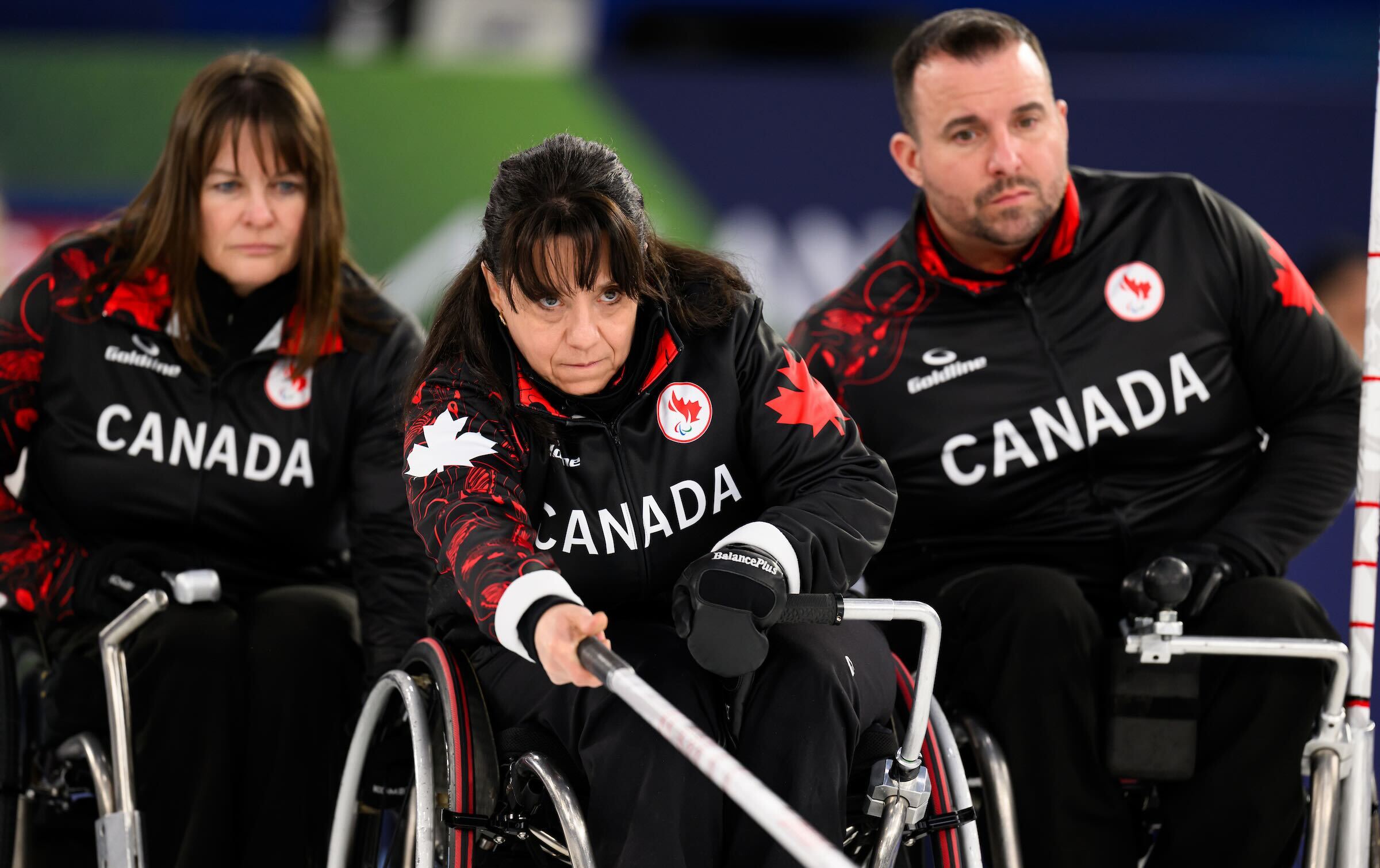
Canada’s mixed wheelchair curling team captured Paralympic gold in dramatic fashion, sealing a 4-3 victory over China with the final stone. For Team Canada lead Collinda Joseph, the moment is still difficult to put into words.
“It’s a testament to the work we’ve done not only as a team, but individually for me for the last 15 years getting into the Paralympics and trying to get to the top of the podium,” Joseph said.
“It’s that goal that you want to reach and when you finally reach it, the feeling is unexplainable,” she said.
The wheelchair curling team was nicknamed “The Cardiac Canadians.” Joseph says her brother’s friend came up with the moniker because the team is so stressful to watch.
The name was rightfully earned.
Canadians were on the edge of their seats watching the last throw of the gold medal game. The clock was ticking down, with Mark Ideson unsure whether Canada or China’s rock was closest to the button.
Ideson delivered the medal-winning shot, tapping his own stone just right. That last-minute decision secured Canada’s gold medal victory at the 2026 games.
Joseph, Jon Thurston, Ina Forrest and Gilbert Dash played alongside Ideson. The team was extremely experienced and connected, Joseph said. She has clinched multiple national and international podiums in the sport.
“We all come with a lot of experience and knowledge, and we all want to share that knowledge with each other, but also want to ensure that we’re working together to reach our goals,” she said.
“The team is really special for that reason.”
The team’s win marks Canada’s first gold medal in wheelchair curling at the Paralympics since 2014. Canada is the only country to medal in every wheelchair curling Paralympics since its introduction in 2006. The team was also the first to complete the round-robin tournament without a loss, going 9-0.
“It taught me a lot about how to ensure that we stay focused on what we can control and let the emotion part stay contained so that you can continue to focus on the technical,” Joseph said.
Joseph said the team kept their reactions guarded to avoid blowing their momentum. But reflecting on it now, she says being a part of a historic team is “incredibly special.”
“It was a thrill to be part of and a thrill to be with these amazing athletes who helped achieve this incredible milestone,” she said.
One of the elements that Joseph loves most about the game is how it’s both an individual and team sport. As an individual, your performance is based on the ability to execute two shots, but the execution of those two shots affects the team play.
This isn’t Joseph’s first Paralympic Games. In 2022, she was an alternate in Beijing, playing one round robin game to help the team secure a bronze medal.
“I felt like I had a lot more to contribute in this event versus what I was able to do in 2022,” Joseph said. “Being on the ice in those big moments was huge. I would not give that up for anything.”
Joseph’s athletic journey has been one of perseverance, determination and courage.
At 18 years old, she was on a trip as part of a language night school course. A train accident while in France left her with a spinal cord injury.
Joseph said her injury pushed her to come out of her shell in high school, which she said never would have happened otherwise.
“I realized that people were afraid to talk to me, and it pushed me to be the first one to initiate conversations,” she said. “I went from being very shy to not being so shy — and trying to help people feel a little bit more comfortable when they were talking to me.”
Joseph said connecting with people who have come away from similar adversity is important for growth.
Following her injury, Joseph pushed forward with determination.
Unable to continue with springboard diving, her former sport, she turned to adaptive activities. Joseph started off with track and field and wheelchair basketball through a rehabilitation centre before turning to curling.
After seeing an ad for a “give it a go day” at the RA Centre in 2006, she decided to give the sport a try.
“I threw a couple stones and thought, ‘Ooh this is really interesting, I really like this.’ That was it. I just got hooked from that point on.”
“The stubborn side of me just kept on pushing through, trying to learn new things and figure out how to throw the stone better,” she said.
Joseph explained curling clubs tend to be inaccessible, limiting spaces where she can train. She also comes up against social barriers for wheelchair curlers. People assume wheelchair curling is easier than it actually is, she said.
“The attitude can be that you belong in your own league rather than being included in other leagues or able-bodied leagues,” she said.
Joseph isn’t ready to step away from the challenging world of curling. She’s got her eyes set on her next goal — making the 2030 team to play in the French Alps.
She encouraged people wanting to explore adaptive sports to find a way that works for them, adding it’s all about being curious and courageous.
“Its really important for people to say, ‘I don’t care what others think about how I’m doing it.’ Just go ahead and do it. Find the way that makes it work for you.”
While she was in the Paralympic village, she tacked up motivational taglines along the wall to help ground her.
“I had one that said, ‘Be courageous.’ I looked at it every day,” she recalled. “The thing that I wanted to do was just to be courageous. That means throw every rock like you want it.
“Don’t be afraid to miss.”
Featured image by Angela Burger/Paralympic Committee
This article, and all of the Charlatan’s work, is brought to you by an independent student newspaper dedicated to informing, uplifting and entertaining the Carleton University community. We are a levy-funded organization which plays a role in the broader, vibrant student culture on campus. By reading this article, you are supporting our efforts.