

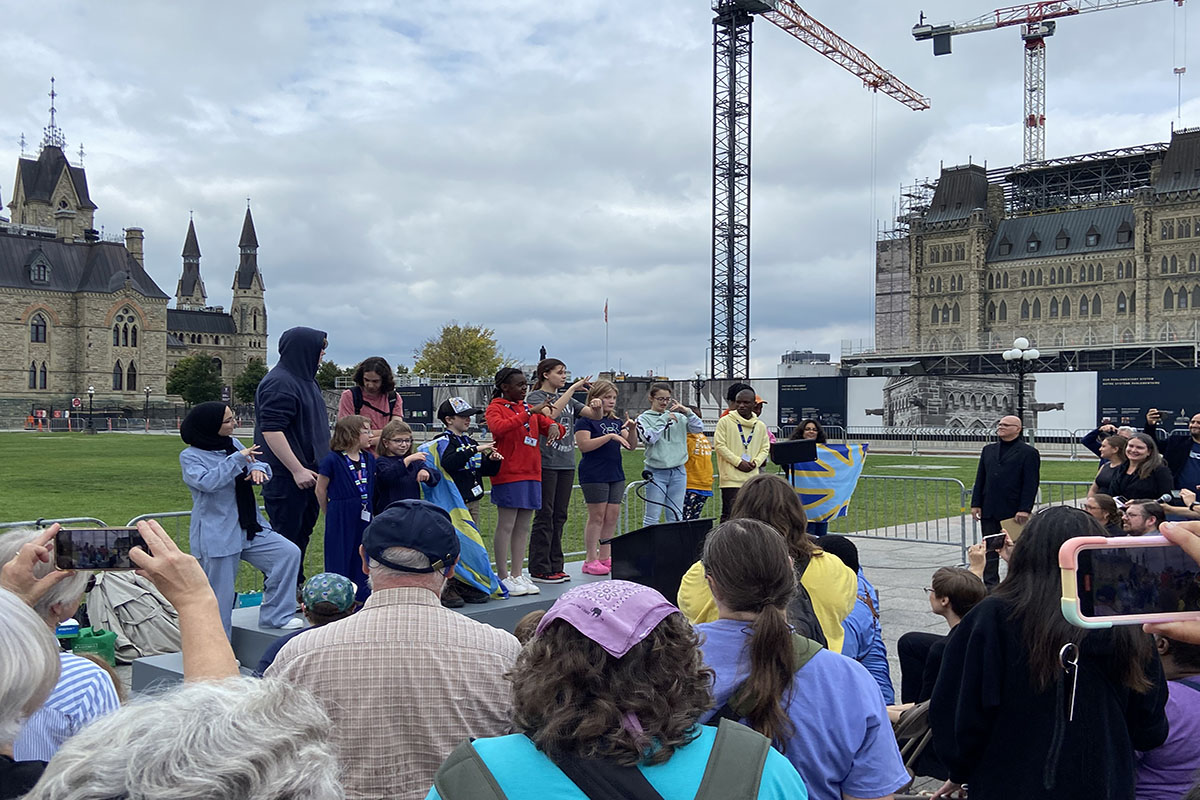
Ottawa celebrated the International Day of Sign Languages on Tuesday by raising the Deaf flag on Parliament Hill for the second time in the city’s history.
“The creation of this flag represents a proud heritage,” Hélène Hébert of the Canadian Association of the Deaf said in American Sign Language.
“In the past, Deaf people have felt ashamed and marginalized compared to not-Deaf people,” she said. “This flag is demonstrating being proud of who we are.”
On behalf of Mayor Mark Sutcliffe, Deputy Mayor Steve Desroches read a proclamation during the ceremony, stating that Sept. 23 will now be formally recognized by the City of Ottawa as International Day of Sign Languages.
After participating in the inaugural flag raising at Parliament last year, Dino Zuppa, CEO of Accessibility Standards Canada, returned with his organization this year.
Zuppa announced at the flag raising that Accessibility Standards Canada is launching the Equitable Communication Standard to “create a barrier-free Canada” by 2040.
He said this standard would further develop accessible communication regulations in the country.
“Accessibility benefits everyone,” he said. “We commit today to continue to work with the Deaf community, to celebrate its diversity and to ensure its involvement in everything we do.”
These standards would ensure that deaf Canadians are included throughout the Canadian government, said Richard Belzile, the executive director of the Canadian Association of the Deaf.
“I foresee that the Deaf community will be included and have equal participation in developing those standards and we welcome that opportunity,” he said in ASL.
Last September, Carleton University raised the Deaf flag for the first time on campus, becoming Canada’s first university to do so publicly — an important step towards supporting Deaf people, DeShaw said.
While Carleton did not host a flag raising event this year, the Deaf flag was still flown for the day on Tuesday at the flag poles on Library Road.
She added that “little by little,” society moves towards equality for Deaf people through recognition events like the flag raising that promote awareness for the community and its culture.
DeShaw added people can support the Deaf community by studying ASL, learning Deaf history and connecting with the Deaf community.
According to DeShaw, it’s important to “educate hearing people to stand with us, work with us” so everyone can benefit from an accessible society.
“We just want people to try to recognize our culture,” Hébert said.
“I hope that the flag stays forever.”
__________________________________________________________________________________
Featured image by Katelyn Stevenson/the Charlatan.