
Post-secondary education in Ontario is monetary freefall, and universities are scrambling to stay afloat.
Financial pressure is coming from every direction: federal immigration policies, tuition caps and the lowest post-secondary funding from any provincial government in the country.
In February, Carleton University’s senate reported the school’s financial position has become “even tighter” since last spring’s projections as the number of international undergraduate students dropped by 55 per cent in a single year.
Facing these financial challenges, institutions like Carleton are turning to alternative funding avenues, including building an “institutional portfolio” and investing in private companies, such as TripAdvisor or Thomson Reuters.
In March, the university updated its investment policies, establishing a set of ethical guidelines for where endowment money can ethically be invested.
But these investments are not as innocuous as they appear. For more than a decade, students have raised concerns over Carleton investing endowment funds into corporations involved in widespread human rights abuses.
Last June, The Charlatan obtained documents which showed that, despite widespread backlash, the university was pouring millions into companies flagged by the United Nations for their participation in Israel’s occupation of Palestine.
One of the key ethical guidelines laid out in Carleton’s Responsible Investing Policy is adherence to the UN’s own Principles for Responsible Investing, which focuses on three overarching considerations: the environment, social issues and governance.
By investing millions into corporations the UN has condemned for human rights violations, Carleton University is contradicting its own stated policies.
It is hypocritical and deeply unethical for a diverse, publicly funded educational institution to invest millions into companies complicit in the genocide of the Palestinian people and the illegal occupation of land in what is now recognized by Canada as the State of Palestine.
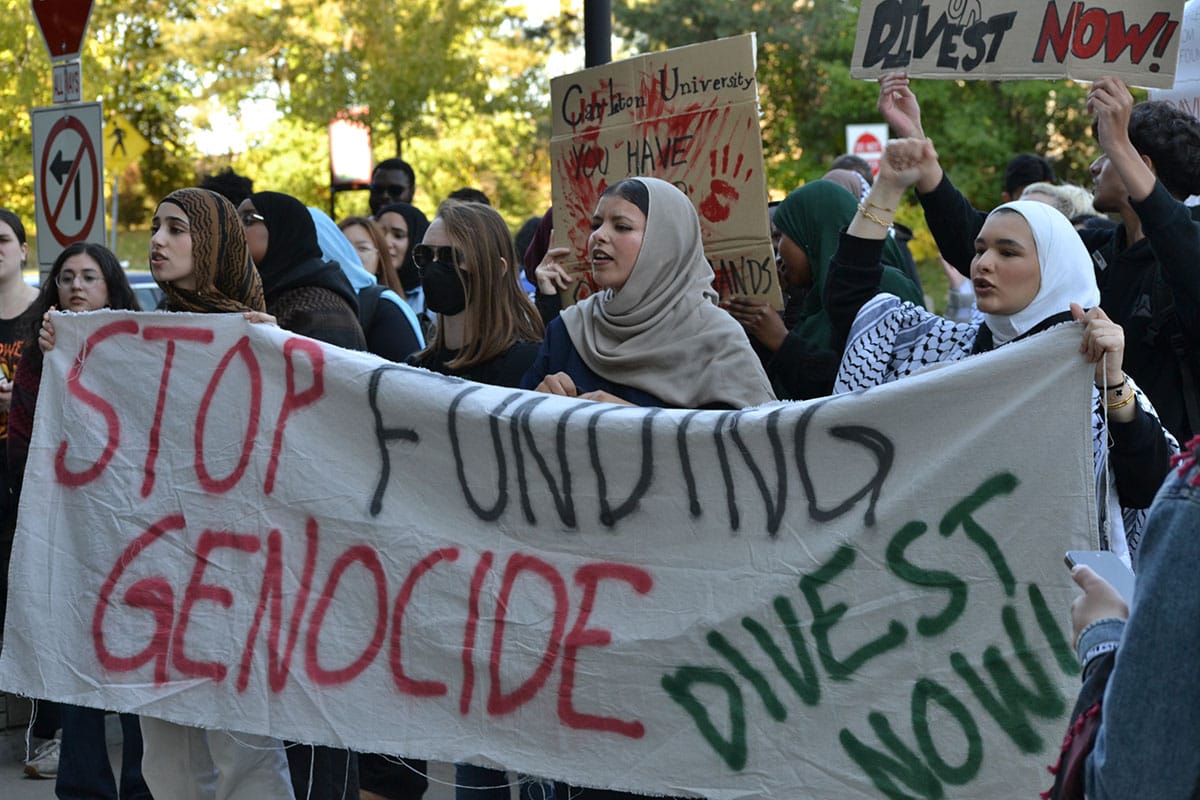
In April, Carleton University declined to abide by calls from student organizations such as the Carleton 4 Palestine (C4P) coalition to divest from companies involved in activities in Israeli-occupied Palestinian territories.
Members of the C4P coalition argue this lack of transparency from Carleton is an example of how the university is beginning to act more like a corporate entity rather than an educational institution.
Carleton University is a publicly-funded institution, not a private corporation – and it should act accordingly.
Whether their money is being directly or indirectly funnelled towards these companies, students and donors deserve to know.
There is, however, hope for change. Past divestment campaigns at Carleton University have successfully pushed the school toward more ethical investment practices.
In the 1980s, public campaigns demanding divestment from South Africa’s apartheid regime came to a head. After years of student and activist pressure, Carleton finally divested from South Africa in 1987, following efforts by the Carleton Anti-Apartheid Action Group and the Carleton University Students’ Association.
More recently, in 2022, Carleton divested from fossil fuel companies contributing to the destruction of our environment and the escalating climate crisis after a campaign by Climate Action Carleton.
Carleton subsequently updated its responsible investment policies to prohibit all fossil fuel investments.
If we wish to make Carleton the accepting and intellectually enriching environment it purports to be — the one students and staff deserve — we must continue to hold it to account.
Universities must start acting like the diverse and democratic institutions they are, rather than as corporations which put profit over people.