Teresa Samson, the First Nation of Na-Cho Nyäk Dun’s heritage manager, remembers hearing “a huge gasp,” during her presentation at a February land claims coalition in Ottawa as she showed a hologram of Elder Jimmy Johnny, who had recently died.
Samson said Johnny was a strong promoter of the Northern Tutchone language and was very interested in the new technology brought to his community of Mayo, Yukon.
Before he passed, he recorded several 3D videos to pass on his teachings.
“We still have a piece of him,” Samson said.
“I think it shows honour to those that were working before us.”
The hologram technology she used is part of a larger project the First Nation is developing with Carleton University researchers.
The project, called Kwän Dék’án’ Do – which means “to keep the fire burning” – represents a desire to protect and strengthen the Northern Tutchone language and cultural traditions.
Kwän Dék’án’ Do includes two parts, according to Troy Anderson, a Carleton business professor working on the project.
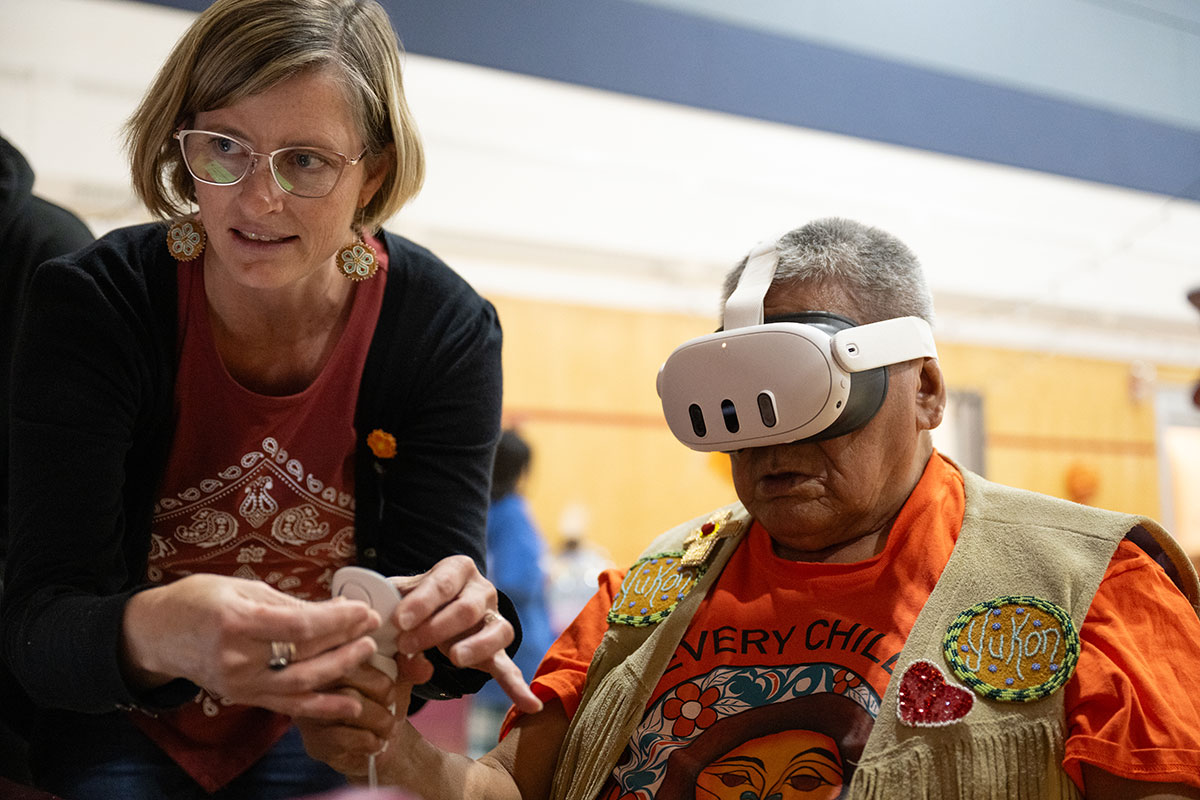
The first part uses holographic and virtual reality technologies to share culturally significant objects, various art tutorials, oral history told by elders and interactive environments like the community cemetery.
The second deploys artificial intelligence to create a digital, interactive language system for the Na-Cho Nyäk Dun dialect of Northern Tutchone.
Carleton students and faculty are currently working on digitizing the language from printed materials and audio cassettes to train the tool.
Samson said it will be similar to a gaming system with avatars that can track its users’ personal language journeys.
“Although it’s modernized, it helps to keep one foot rooted in tradition,” Samson said.
The group hopes the machine will appeal to children in particular, who Samson said have been “blown away” by the technology so far.
Melody Hutton, a young elder and heritage and culture officer for the First Nation, said there are fewer than a dozen fluent speakers of the dialect left.
“Language is our life,” she said. “I hope and pray this project is going to save our dialect of Northern Tutchone.”
“(Elder) Walter (Peter) is always saying, ‘Without language, you have nothing. You have no identity,’” Samson added. “That is how you know who you are as a people, and in order to know your land, you need to know your language.”
While this information will be accessible from a large unit with a screen that is currently in the First Nation’s government building, the information will also be available to all Na-Cho Nyäk Dun citizens from their own devices in a 2D format.
“It’s making cultural assets that normally might not be available to everyone in the community available to them,” Anderson said.
Samson said the community has been facing a drug epidemic, leaving a young generation without parents to teach them aspects of their culture.
“Even if they don’t have that at home, at least they will have a piece of how it works… because they will be learning it from elders and land guardians and people that actually know the traditional practices.”
The most important part of the project — and of Carleton’s 40-year relationship with Na-Cho Nyäk Dun — is community leadership and ownership, Anderson said.
“What we’re doing is we’re making this possible from a technological perspective, but all of the decision making about content… all of those things are decided by the First Nation, not us.”
Although Kwän Dék’án’ Do has a three-year term as a Carleton project, Hutton said it will leave a lasting legacy.
She added the impact could go beyond Na-Cho Nyäk Dun, with other First Nations already inquiring about the project.
“It’s going to be there ‘til the end of time, and we’re just going to keep on adding and adding.”
_______________________________________________________________________________________
Featured image by Andrew Serack.