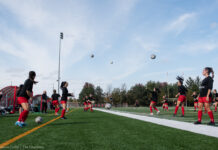


From the stands, varsity sports are pure spectacle, with fans, school pride and highlight-reel moments.

But for student athletes like Avery Krawchuk, the grind begins long before game time. Morning practices, busy class schedules, travel weekends and late-night studying all compete for the same limited number of hours.
“Sometimes it literally feels like there’s not enough hours in the day,” said Krawchuk, captain of Carleton Ravens women’s hockey team and a fourth-year engineering student.

Behind the big moments and championship banners is a reality defined by relentless time management, self-imposed pressure and a mental load that can rival the physical demands of sport. While fans see performances, athletes juggle lectures, labs, part-time work, travel and increasingly, their mental health.
“Our student-athletes experience mental-health disorders at higher rates than the general student population,” said Grant Pell, a registered psychotherapist who works closely with varsity athletes at Carleton. “Burnout is a common complaint in counselling.”
The balancing act
For Krawchuk, balancing engineering and hockey requires constant precision. In season, the team practices three to four times a week, with two extra workouts focused on maintenance and recovery. Off-season training ramps up with strength sessions, conditioning and development skates.
But it is not just the physical workload that weighs on her.
“Most of the pressure was honestly coming from myself,” the 22-year-old student athlete said. “When I’m not performing well on the ice or in school, it really bothers me.”
Limited flexibility in engineering course offerings makes travel particularly difficult. Midterms can collide with away games, forcing early communication with professors and, at times, deferred exams. Missed material must be recovered through classmates’ notes and late-night study sessions.
“Travelling is super hard, especially in engineering,” she said.
The hardest moments come when both school and sport aren’t going her way.
“Usually if one is down, I’m fine,” she said. “But when both are struggling, that’s hard.”
Still, hockey has shaped her identity since her childhood.
“It is a very big part of who I am,” said Krawchuk, who is from Calgary and has played hockey since the age of three.
That identity, Pell said, can become both an anchor and cause vulnerability.
“For so long they have been an athlete,” he said. “Who would I be without this?”
Very few university athletes go on to play professionally. When eligibility ends, some experience a profound sense of loss, he said, describing themes of grief and identity confusion in counselling sessions.
Pressure to prove

For first-year running back Samson Green, the pressure feels different. But it’s still intense.
Green, an 18-year-old from Riverview, N.B., plays for the Carleton Ravens football team and spends about 30 to 35 hours a week at meetings, lifts and practices during the season. Daily team meetings begin at 8 a.m., followed by classes, workouts and evening practices that stretch until 8 p.m.
Mandatory rookie study hall fills in the remaining gaps.
“It’s definitely a big commitment,” the health science student said. “But it’s manageable.”
This season, Green’s primary opponent has not been another team — it’s been his own body.
Green tore his ACL in Grade 11, and re-tore the ligament during rehabilitation. He underwent surgery again in September 2025. He’s looking to return to the field next year, more than 800 days since his last game.
“That was very hard, mentally and physically,” he said about the week after surgery. “I shouldn’t have been in class.”
Despite the setback, the time commitment did not shrink. Rehabilitation sessions added hours to an already packed schedule. Coaches adjusted lifts, and professors offered flexibility, but the internal pressure remained.
“I feel like I got a lot to prove,” he said. “I’m getting money to be here … I want to show them I’m worth it.”
Green said stigma lingers despite conversations about mental health becoming increasingly prevalent in sport. Pell said he sees surprisingly few athletes in his caseload, despite being a designated contact.
“There is so much stigma,” Pell said. “Fear of being benched until they are ‘better’ is a common complaint.”
Institutional expectations

From the university’s perspective, the goal is balance.
“We look at the full life cycle, which incorporates both their performance from an athletic perspective and from an academic,” said Kwesi Loney, director of high-performance sport at Carleton. “For me, it’s all about the balance.”
Carleton encourages athletes to complete academic audits, map out graduation requirements and, in some cases, take summer courses to ease pressure during the season. Tutors, academic advisors and mental performance coaches are available, too. QR codes are also posted in athletic spaces to allow discreet booking with counselling services.
“Being a student athlete is extremely demanding,” Loney said. “To put value into both at an equal level and excel at that is a tremendous accomplishment.”
At the provincial level, the OUA enforces academic eligibility standards and recognizes Academic All-Ontario athletes who maintain an 80 per cent average.
OUA president Gord Grace said today’s athletes face heightened scrutiny from fans, particularly through social media.
“Being a student athlete has always been challenging,” Grace said, adding that Canadian university sport emphasizes education over commercialization, unlike the NCAA in the United States.
Grace said he believes the Canadian university sports system provides a better experience for people to be students and athletes compared to students being set up like professional athletes in the NCAA.
“They’re thinking that maybe somehow our sport is inferior to the NCAA experience and I think it’s the opposite,” Grace said.
More than a single play
For Krawchuk, public perception remains one of the most frustrating elements. A missed shot or defensive error can prompt criticism from fans unaware of the exam written hours earlier or the assignment due at midnight.
“People don’t realize how much it takes to be a varsity athlete,” she said. “There’s way more to it than just the specific error you’re seeing.”
Spectators cannot see the months of rehabilitation it takes to play, Green added.
As universities continue to promote both athletic excellence and academic success, the athletes living at this intersection remain caught in a delicate balancing act — one that demands resilience, organization and, at times, sacrifice.
“A student athlete’s life is not roses,” Loney said. “It is passion. It is a sport they love. But it’s at a very high demanding level.”
Featured image from Handout/Second Edition
This article, and all of the Charlatan’s work, is brought to you by an independent student newspaper dedicated to informing, uplifting and entertaining the Carleton University community. We are a levy-funded organization which plays a role in the broader, vibrant student culture on campus. By reading this article, you are supporting our efforts.