
Advocates and Carleton University students say a new Coordinated Accessibility Strategy comes as a relief. The strategy serves as a framework for the university to ensure accessibility on campus.
Five years after a previous version launched in 2020, the new version incorporates feedback from students and faculty with accessibility needs.
“The strategy is a framework that sets out these broader, longer term objectives and actions for a more accessible campus,” said Cathy Malcolm Edwards, the lead of the accessibility strategy working group.
The strategy breaks down seven different areas of focus for improving and maintaining conditions for accessibility on Carleton’s campus, outlining the objectives and actions that will be taken for each focus group.
Some planned improvements include creating institutional policies to make accessibility a priority in university decision-making, providing incentives and training to educators to make classrooms more digitally-accessible, and improving campus signage, digital maps, and building pages.
Stephanie Evans, chairperson at the National Educational Association of Disabled Students, said she was amazed by Carleton’s plan.
“It was so clear and direct, and the seven points [of focus] are exactly what [people with disabilities] need,” Evans said, adding the seven focus points are “exactly” what people with disabilities are asking for.
“Every university should have this.”
The strategy also focuses on consulting Carleton students living with disabilities and plans to ensure students are involved in the decision making process.
In the fall, the university will invite Carleton community members to be part of an advisory group for the strategy, Edwards said.
“I find that a lot of universities have missed communication and don’t consult with people with disabilities,” said Evans. “People with disabilities want to be seen, heard and supported, and I think this strategy plan is a great thing, a great step.”
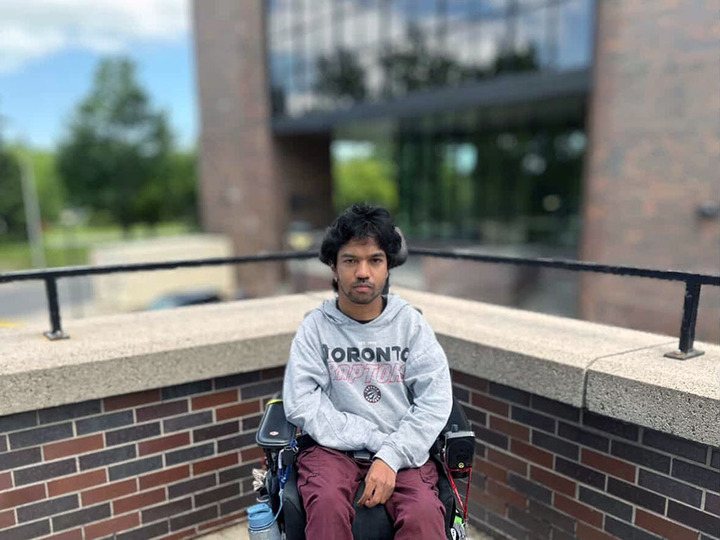
Maheeshan Sivanesan, a fourth-year computer science student at Carleton who uses a wheelchair, said he’s looking forward to seeing how the strategy makes the campus more accessible.
“Sometimes I feel like even the minimum requirements aren’t met in some places or on campus,” he said.
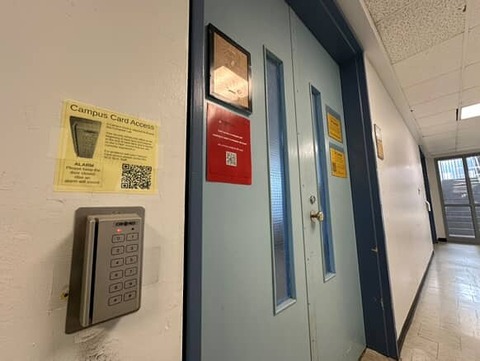
Sivanesan used a QR code outside Herzberg Laboratories’ teaching assistant lab on the fourth floor to provide feedback on the room’s inaccessibility. The heavy door requires a keycard to unlock, with no door opener available.
“It’s only me that’s in the office on Friday afternoons, so there’s no one there to open the door for me,” Sivanesan said.
After responding via the QR code, Sivanesan heard back, with the university saying they’re working on purchasing and installing a door opener.
“A door opener is the bare minimum for most rooms with heavy doors,” Sivanesan added.
Carleton’s standards can feel “so low,” said Eulalie Reesink-Babillon, a third-year humanities student with a general learning disability and attention deficit disorder (ADD) who said she was excited to hear about the public feedback process.
“Carleton is pretty good about [accessibility],” said Reesink-Babillon. “It’s just that the standard is so low for everything else, there’s definitely room for improvement.”
The strategy itself was created from several consultations with disabled faculty and students in the Carleton community, Edwards said.
“It’s at the center of everything we’re doing,” Edwards said. “We really subscribe to the ‘nothing [about us] without us’ approach.
“We’re really working on how to build trust, reduce barriers and reflect that kind of ethos.”
Evans said she believes more universities and colleges in Canada need to take similar steps.
“Collaboration and communication is gonna make the big change,” she said. “Having personal experience is key because those are the people that know what’s happening, what kind of barriers there are.
“Being able to have those hard conversations … makes a big difference.”
Featured image provided by Walid Abdel-Jabbar