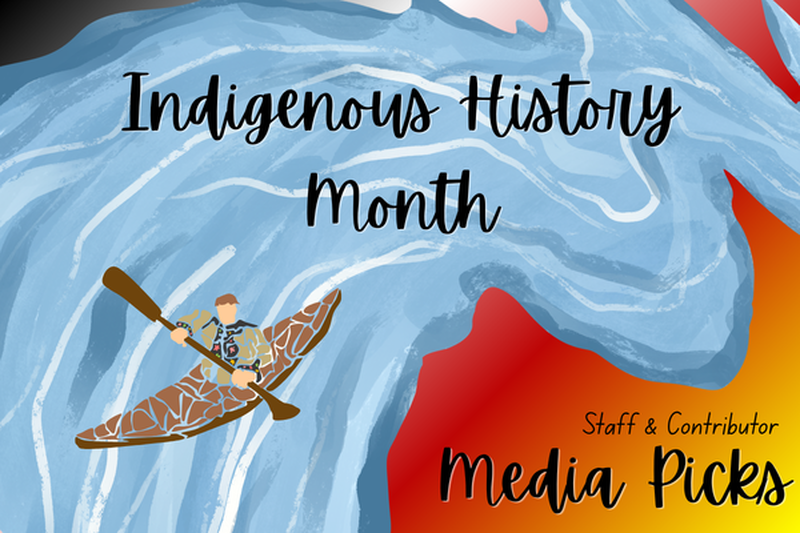
This June marked Indigenous History Month in Canada: a time to honour the Indigenous peoples of Turtle Island and their history, heritage, contributions and communities.
The Charlatan’s editors and contributors have compiled some of our favourite Indigenous artists, athletes and TV shows.
Check out some of our recommendations and favourites below and discover your own to continue supporting Indigenous peoples and their work.
Sophia Laporte: Arts Editor, vol. 56
Indigenous History Month media pick: Tia Wood
I first discovered Tia Wood when she joined Shawn Mendes on stage at his Vancouver concert at Rogers Arena and duetted his song “Youth.” Wood elevated the song with powwow elements and her deep, melodic and emotionally compelling vocals.
I was especially moved by her addition of a powerful verse about missing and murdered Indigenous women and girls that seamlessly blended into Mendes’ original song.
Beyond powerful duets, Wood’s music is an iconic powerhouse of vocals and instruments on its own. A Cree and Salish singer-songwriter from Saddle Lake Cree Nation, Alberta, she blends traditional Indigenous vocals with contemporary pop and R&B elements.
Her song “Dirt Roads” speaks to her experience as a singer-songwriter seeking to pursue her dreams in a big city after leaving home. Wood sings of struggling with feelings of cultural displacement away from her Indigenous roots and traditions as she sings lyrics of “Should I take out my braids or leave ’em in? / They look at me like I’m a Martian.”
One of my personal favourites from her is “Losing Game,” but her whole discography leaves much to enjoy, and I hope you can take the time to enjoy it the way I did.
Marissa Meilleur: Culture & Community Editor, vol. 55
Indigenous History Month media pick: Reservation Dogs
Reservation Dogs broke ground for Indigenous representation in television.
Behind the scenes, an all-Indigenous writer’s room, crew and regular cast built the show. The result of this trailblazing team is a series that portrays Indigenous communities in a way that rarely makes it to screen.
Starring four young teens who recently lost one of their best friends to suicide, Reservation Dogs is a coming-of-age story about family, friendship, loss and community.
I remember bonding over this show with my brother, as we howled with laughter one minute, and nearly cried the next. Coming from a Tlingit family, we related to the humour in ways that few shows have replicated for us.
A comedy by genre, Reservation Dogs strikes the perfect balance between humour — an integral part of many Indigenous cultures — and not shying away from the trauma so many communities face.
Storylines across generations provide insight to the intergenerational trauma in Indigenous communities, while also nodding to their emphasis on respecting elders and uplifting youth.
Bringing together some of Hollywood’s legacy Indigenous actors like Gary Farmer and Graham Greene, while introducing a new generation of stars in D’Pharaoh Woon-A-Tai, Devory Jacobs, Paulina Alexis and Lane Factor, Reservation Dogs embodies the start of a new era in Indigenous television.
Michael McBean: Editor-in-Chief, vol. 56; News Editor, vol. 55
Indigenous History Month media pick: Gavin McKenna
As a Toronto guy, hearing Gavin McKenna’s name called first overall in this year’s NHL Draft was a pretty cool moment.
But McKenna’s story is about more than hockey. A citizen of the Trʼondëk Hwëchʼin First Nation from Whitehorse, Yukon, he’s become one of the most exciting young players in the sport while representing a community that has rarely been visible at hockey’s highest levels.
At just 18, McKenna has already accomplished plenty, helping Canada capture international gold while emerging as one of hockey’s brightest young stars. His success shows Indigenous athletes that they belong at the top of the game, too.
As a Torontonian, I’m excited to see what he does next, especially with the talent he’ll be surrounded by. I have a feeling Leafs fans will be talking about Gavin McKenna for a long time.
Kathan Kapoor: Culture & Community Editor, vol. 56
Indigenous History Month media pick: The discography of Robbie Robertson
As a child, road trips in Ontario always came with a soundtrack consisting of classic rock radio stations. Whether it was Boom 97.3 or Q107, there were songs that seemed to follow every trip I went on. Among the standards was “The Weight” by The Band, which became recognized as an all-time great by songwriters when it was released in 1968.
Years later, I learned that one of the writers was Robbie Robertson, of Cayuga and Mohawk heritage. After experiencing systemic racism at school from his peers and his mother telling him, “Be proud that you’re an Indian, but be careful who you tell,” Robertson began to embrace his identity through his art.
In 1987, he merged Haudenosaunee musicality and oral storytelling with rock instrumentation on his self-titled album Robbie Robertson to platform his culture to a broader audience. In 1994, he released the album Music for The Native Americans, which was used for a documentary that delved into various Indigenous communities.
Robertson was also vocal about supporting Indigenous individuals pursuing post-secondary education. He even collaborated with Martin Guitars to sell an acoustic guitar with all proceeds going towards Indigenous schooling.
Although Robertson passed away in 2023, his legacy lives on, displaying how culture is foundational to art and should never be silenced.
Jake Steele: Sports Editor, vol. 56
Indigenous History Month media pick: the Ottawa Charge’s Jocelyne Larocque
If you ever get the chance to watch the Ottawa Charge, Jocelyne Larocque is impossible to miss. The defensive stalwart is of Métis heritage and is recognized for both her Olympic-level talent (15 international medals, impressive, right?), and her commitment to uplifting Indigenous youth.
Larcoque is the first Indigenous woman to compete in Olympic women’s ice hockey, and recently became the most decorated Indigenous athlete in North American Olympic history. On the ice, everyone can see her overwhelming confidence and poise with the puck, making everyone around her better.
She was awarded the Tom Longboat Award, which recognizes her outstanding contributions to sport as an Indigenous athlete. With the Manitoba Indigenous Female Athlete of the Decade award and the Order of Manitoba under her belt, she also works with First Assist to help students in Indigenous communities find success in school through sport.
Larocque’s character screams inspirational. Her community work, on-ice excellence and advocacy for Indigenous athletes on the big stage makes her an Indigenous role model in her community, Red River Métis, and across the country.
Remember these qualities, because Larocque is the frontrunner (in my opinion) to wear the ‘C’ in Ottawa next year.
Simon McKeown: News Editor, vol. 56; Photo Editor, vol 55
Indigenous History Month media pick: Elisapie
I first heard Elisapie’s ethereal music on CKCU-FM, the community radio station just a few doors down from the Charlatan. It was her song “Taimangalimaaq (Time After Time)” from her then new(-ish) album Inuktitut, a project entirely dedicated to remaking popular songs in her mother tongue.
That album won two Juno awards in 2024 and 2025 — and for good reason. She’s a superb singer, with a mind for capturing and communicating sounds into emotions. Her song “Qaisimalaurittuq (Wish You Were Here),” which is a remake of the Pink Floyd classic, elicits new feelings that the original never did for me.
Born in Salluit, Quebec to an Inuk mother and a father from Newfoundland, Elisapie was immersed in music from a young age. Now, alongside her music, she’s also known as a filmmaker, actor and activist.
It’s safe to say that Elisapie’s music has seeped deep into my mellow, chill playlists. It’s refreshing no matter how many listens I tally up.
Nathan Cox: Volunteer contributor, vol. 55 and 56
Indigenous History Month media pick: Jeremy Dutcher
Born and raised in Fredericton, New Brunswick, Jeremy Dutcher is an Indigenous classically trained musician who combines a deep understanding of musical theory and musical history achieved through their studies at Dalhousie University with the traditional Wolastoqey language of the Wolastoqiyik people.
As a two-spirited Wolastoqiyik member of the Tobique First Nation of New Brunswick, Dutcher exploded onto the music scene with his self-released 2018 album “Wolastoqiyik Lintuwakonawa.” The album, written and performed in Wolastoqey, features wax cylinder recordings made between 1907 and 1914 of Wolastoqiyik peoples singing their traditional songs. Dutcher dubs over them with stunning classical arrangements and complements the songs with his own use of his language.
I first heard Dutcher’s music in middle school and was mesmerized by the ethereal sound of the wax cylinder recordings. There is an eerie sadness that builds into beauty when listening to Dutcher’s music, especially on his first album. The opening track Mehcinut is a must-listen for everyone.
Above all, his relationship with New Brunswick, its culture and its people is what makes him my pick.
Kyla Silva: News Editor, vol. 56
Indigenous History Month media pick: Anachnid
Anachnid is an alternative Oji-Cree musician based in Montreal who mixes electronic beats with melodic whispers and a deep bass line making her music feel as if it’s playing in your chest.
Anachnid blends Indigenous stories into her music like some of her top tracks “Windigo” and “Sky Woman.” Her ability to blend spoken lyrics and electronic beats creates an easy listening balance for anyone trying to dip their toes in alternative electronic music for the first time!
The best place to start in her discography is “Love Alone,” my favourite song. With a steady drum, layered stringy electronic ambience, whistling and melodic lyrics in French and English, it’s a complete showcase of Anachnid’s talent and will undoubtedly get your body swaying.
Jaidyn Gonsalves: Volunteer contributor, vol. 55 and 56
Indigenous History Month media pick: Wyatt C. Louis
Quivering and undeniable, Wyatt C. Louis channels the wavering presence and unwavering love of generations into their delicate melodies. Like a secluded campfire in the heart of a storm, Louis’ warm tone invites listeners to cuddle up in the comfort of the tenderest spaces Louis has called home—from sunlit mountaintops to treacherous train tracks.
A Plains Cree artist raised on Hendrix and The Beatles still discovering their place in the indie-folk genre, Louis carries the stories of everyone they have ever respected on their back, picking and patterning their strings with their full breath, practically gasping to replant the impact of their loved ones in the ears of anyone who will listen.
Louis caught me, eyes soaked, at a Leith Ross concert with “Carefree” off their first album Chandler for the first time this past April. I had prepared for a night of sorrow and enlightenment being well-versed in Ross’ poetic prowess but to think that Louis had been hiding such guttural kindness and such sky-dividing vocals left me only a game of catch-up in the night’s wake.
At a time riddled with illusions of intimacy, Louis is a peek at an alternate reality: one where connection guides survival. Their music and their message begs listeners to open their eyes, truly, and treasure how much it means to know one another.
Syd Robbescheuten: Features Editor, vol. 56
Indigenous History Month media pick: Ribbon Skirt
What makes a track memorable? In many cases it’s biting lyrics and memorable sound. Anishinaabe rock duo Ribbon Skirt is a growing bright spot in the indie rock scene.
Ribbon Skirt, with over 8,000 monthly Spotify listeners, blends post-punk and shoegaze with attention to atmosphere, providing a unique listening experience.
Their track “Deadhorse” uses haunting vocals and descriptive lyrics to paint an eerie atmosphere. The track uses noise to create an unsettling environment layered on with surreal lyrics about watching someone floating through the ceiling.
In terms of atmosphere-building though, their track “Mountains” shines. “Mountains” uses ambient forest sounds before building to the first chorus, transporting listeners to another environment.
Off Rez by the group stands out among their works for how overt the themes of political injustice are. The track is a political statement with lead singer Tashiina Buswa speaking to systemic injustices that Indigenous peoples face in Canada.
While politics is nothing new to post-punk music, Ribbon Skirt continues to use punk as a way to create intricate and unique tracks that call out injustice.
Featured graphic by Sophia Laporte/the Charlatan.
This article, and all of the Charlatan’s work, is brought to you by an independent student newspaper dedicated to informing, uplifting and entertaining the Carleton University community. We are a levy-funded organization which plays a role in the broader, vibrant student culture on campus. By reading this article, you are supporting our efforts.