

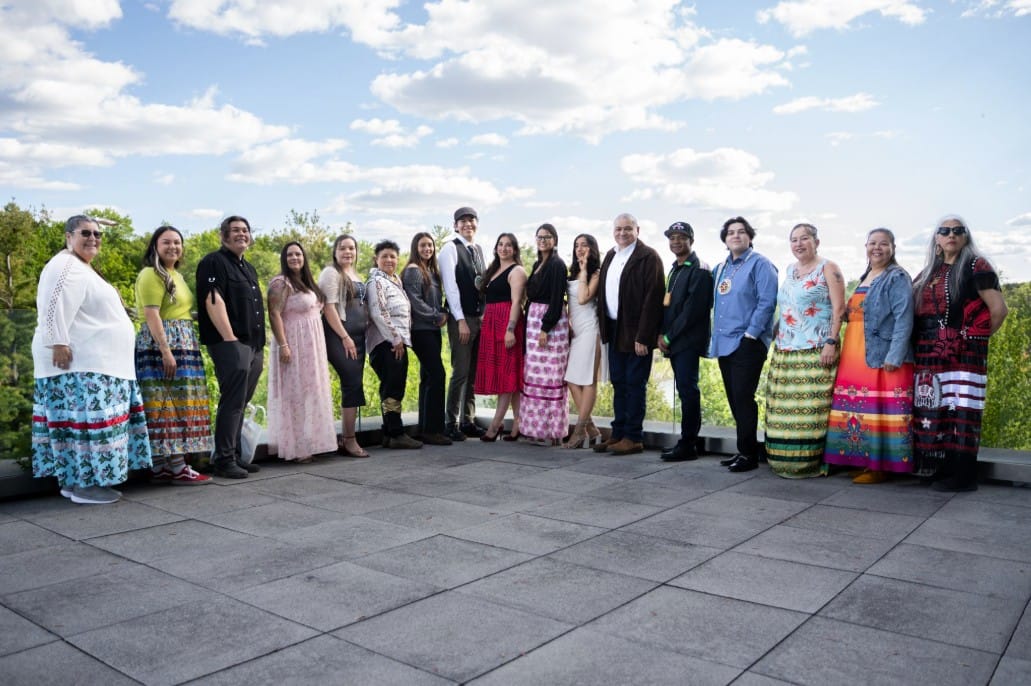
One year after the program’s launch, the inaugural cohort of the Certificate in Journalism in Indigenous Communities (CJIIC) graduated on May 30.
Students along with their friends and family were greeted by the Ottawa River Singers, a drum group who were playing songs at Richcraft Hall to celebrate the commencement of the 17-student cohort.
Established by Carleton University Professor, Duncan McCue, the certificate program is designed to make journalism more accessible for Indigenous students by allowing them to complete classes from their home communities.
The year-long program teaches foundational journalism courses through a hybrid model, consisting of online classes and three in-person intensives.
The three intensives lasted six days each and aimed to provide students with hands-on experience. The first took place in September at Kenjgewin Teg on Manitoulin Island, with the second and third taking place at Carleton in February and May.
The certificate covered food, travel and accommodations for all students, if needed.
McCue led the first intensive on Manitoulin Island at Kenjgewin Teg, which focused on how students can use their exposure to Indigenous storytelling in the context of journalism. He stressed that Indigenous storytelling and journalism have differences which students must keep in mind.
The intensive highlighted the importance of the land and ceremony, and provided students the opportunity to go to a sweat lodge so they could see “how important storytelling was to carry out ways of knowing.”
During the intensive in February, students spent time with instructor Rhiannon Johnson who is a producer for CBC radio show Unreserved, which delves into Indigenous community, culture and conversation.
Students produced a newscast spotlighting stories about Indigenous life in Ottawa in five demanding days at Carleton’s audio studio.
Graduate, Shantel Sault said the hybrid model of the certificate which allowed Indigenous students to take journalism classes from the comfort of their communities was convenient but also posed challenges.
“Connecting with humans through a screen can be difficult, especially for older folks who are less technologically inclined, but those intensives helped with that.”
The graduation celebration began with statements from McCue, reflecting on the land the group was gathered on. He said he imagined those that first arrived on the land hauling their canoes together.
“I bet they lit a fire and they sat around and they may have shared a story or two,” he said. “So this is by no means the first Indigenous celebration that has ever happened in this place.”
Then, the program’s cultural advisor Marilyn Debassige led a smudging ceremony which was a common practice at each class on Tuesdays and Thursdays over Zoom.
At the graduation, Carleton president Wisdom Tettey said it is imperative students use the knowledge and skills they gained to represent their communities honestly.
“To be empowered with all the tools that you need to be able to tell your story in very authentic ways that help to lift is such a privilege,” he said.
After speeches from the program’s partners, all 17 graduates walked to the stage in succession with pride to receive a canoe paddle and share a few words.
“Whether it was calm waters or whether it was rocky waves, you all paddled the canoe together,” said McCue.
Sault spoke to the impact that the community of writers and professors had on her during the nine months.
“We all connected and it was so easy to come together, start laughing and joking, sharing our stories and eventually sharing tears,” she said. “We quickly became a family.”
Trevor Green, who taught the course Foundations of Journalism, said it was fulfilling to watch his class gain knowledge about the media landscape and apply it to their own work.
“Their ability to use news judgement, interview people and recognize disinformation was incredible,” he said. “The certificate was this huge canvas and they threw all the paint they could on it.”
Sault said she would implore anybody to apply for the certificate, despite the nerves that come along with it.
“If people are feeling the same way that I was when I wasn’t at the best place in my life, this certificate could be the light for them to help see through the fog.”
Featured image by Manuel Baechlin
This article, and all of the Charlatan’s work, is brought to you by an independent student newspaper dedicated to informing, uplifting and entertaining the Carleton University community. We are a levy-funded organization which plays a role in the broader, vibrant student culture on campus. By reading this article, you are supporting our efforts.