


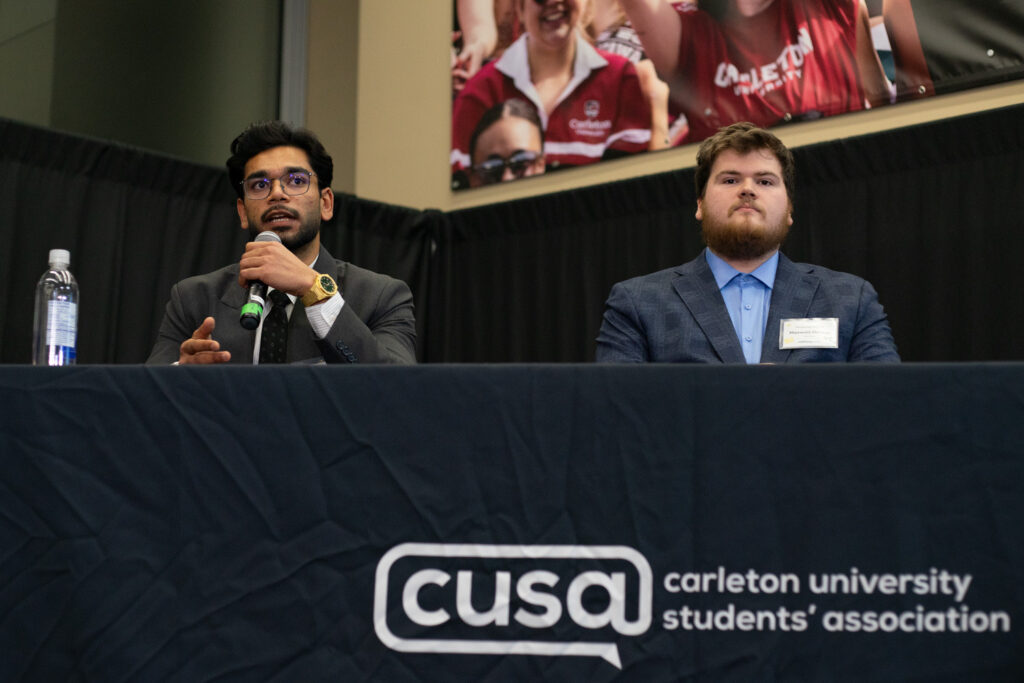
The appeals committee of the Carleton University Students’ Association has overturned the possibility of multiple disqualifications for both of the union’s presidential candidates, Maxwell Heroux and Aryan Singh.
CUSA general election results are set to be announced on Friday.
In a slew of recently published appeals decisions, the committee set aside multiple decisions made by the association’s chief returning officer (CRO), Basit Ur Rehman, which found both candidates or their campaign teams had committed several violations of the association’s Electoral Code.
All the potentially disqualifying decisions were automatically sent to the appeals committee for review.
According to the association’s Appeals Policy, the committee is responsible for deciding if a lower decision maker — in this case, Ur Rehman — made a mistake of fact, a mistake of law or an unreasonable or disproportionate decision.
After the committee’s review, Heroux has nine demerit points from a previous total of 58, and Singh has four demerit points from a previous total of 41. That means neither candidate has met the Electoral Code’s disqualification threshold of 10 demerit points.
Ur Rehman did not respond to the Charlatan’s requests for comment about the overturned decisions in time for publication.
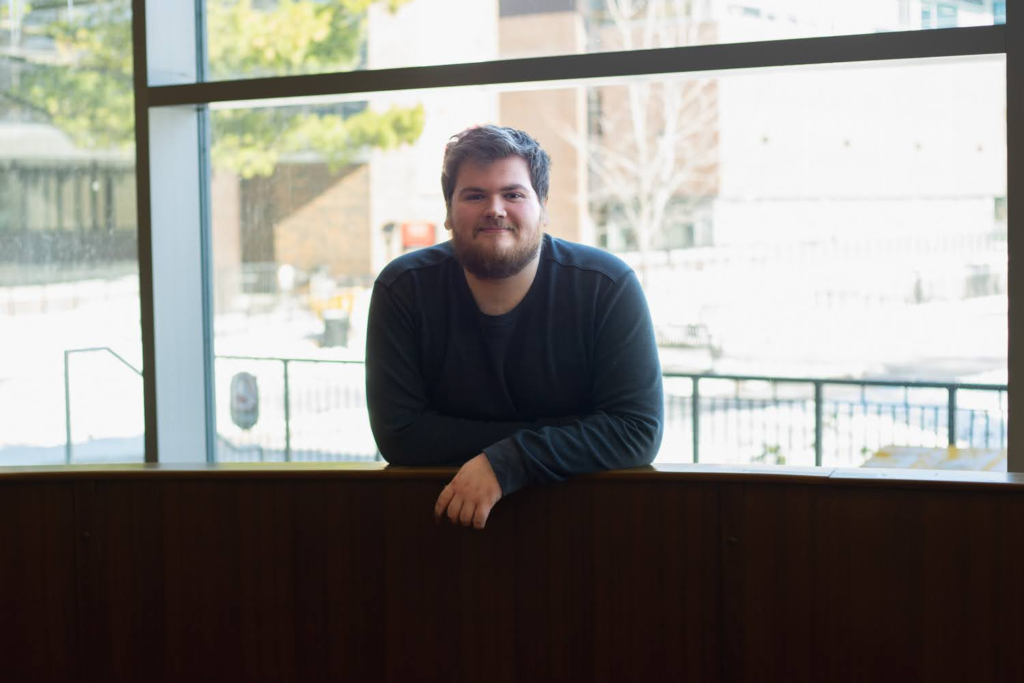
Maxwell Heroux; 9 demerit points down from 58
The appeals committee overturned four of the CRO’s previous decisions, eliminating 49 of the 58 demerit points Heroux received for electoral offences. Five of the remaining demerit points were upheld, and four were not reviewed by the committee.
These offences include coercion relating to executive participation, improper voter influence by a campaign team member and failure to disclose campaign affiliation, as well as conduct undermining the integrity of the electoral process.
“The Appeals Committee was completely fair and justified in overturning every complaint that it did,” Heroux wrote in a statement to the Charlatan. “The decisions made by the CRO were consistently based on a misunderstanding of the Electoral Code and failure to understand the facts in front of him.”
12 demerit points overturned against Heroux for coercion, bribery, improper team member conduct, undermining electoral process
The appeals committee overturned the CRO’s No. 3 ruling, which issued 12 demerit points to Heroux and included allegations of coercion, bribery and conditional offers, improper conduct by a campaign team member and undermining of the electoral process.
According to the appeals decision, the allegation of coercion, bribery and conditional offers was based on text messages between Heroux and the complainant. The complainant was “extremely fearful” of potential harassment, retaliation and physical harm, and did not want the messages to be shared to anyone except the CRO, the CRO said.
This meant the evidence could not be presented during the hearing, an “untenable position” that led the committee to “set aside” the allegation based on procedural unfairness.
The second allegation was based on a message exchange between Nathan Harlan and an elector. Harlan is a Carleton Academic Student Government councillor and part of Heroux’s campaign team, according to the allegation. Harlan and the elector were not called to provide evidence during the hearing.
According to the decision, the CRO said Harlan did not tell the voter he was working with Heroux, even while criticizing a platform point of the opposing candidate, constituting “improper voter influence.”
The committee, on the other hand, found the conversation was “awkward but unremarkable” and not improper voter influence.
They also said it was unclear which specific electoral offence was committed since the CRO’s initial ruling referred instead to the candidate’s declaration. (That is a contract candidates sign to affirm their commitment to abide by the electoral code, CRO rulings and appeals decisions).
The third and final allegation of undermining the electoral process was also set aside because it was based on the previous two allegations. The committee added it is not commenting on whether the allegations constituted undermining the electoral process.
Appeals committee overturns Heroux’s 17 demerit points for recorded library incident
The appeals committee overturned the CRO’s No. 8 ruling to issue Heroux 17 demerit points for allegations from a complaint and video evidence about an individual campaigning for the candidate inside MacOdrum Library. The library is a prohibited campaign location. The CRO found the activity “materially benefited” the candidate.
The CRO also separately found that the interaction was voter intimidation and a violation of ballot secrecy, as the voter’s screen was visible as the individual told her who to vote for, the appeals decision says.
Most of the “factual underpinning” of the incident was not disputed, according to the decision, including that:
- The video was recorded in the library during the campaign period;
- The CRO did not know the identity of the person or the elector and their faces were not captured on camera;
- Candidates knew campaigning in the library was banned;
- There was no evidence the solicitor was linked to Heroux beyond campaigning for him, or that Heroux and his campaign team were aware of the person.
Heroux argued there were “numerous indications” the incident was staged, the decision says.
“The unidentified individual seemed unfamiliar with the candidate he was purportedly supporting, saying Heroux’s name as ‘Heroux Maxwell,’” the decision says.
The appeals committee said it had “grave reservations” about the authenticity of the recorded event, noting the complainant started recording before the campaigner mentioned Heroux’s name, and there was “scripted air” to the encounter.
The CRO’s No. 8 ruling also found the recorded library incident violated rules around free and fair elections, undermining the electoral process and/or disclosing campaign actors.
Because the appeals committee found it could not attach Heroux to the incident, it threw out the CRO’s rulings on the other offences, the decision says.
The CRO’s decision No. 13 was set aside on the same grounds as No. 3 and No. 8, according to the appeals committee’s decision.
10 demerit points overturned for Heroux due to Instagram screenshots evidence
The appeals committee also overturned the CRO’s No.9 ruling to issue 10 demerit points against Heroux for allegations that he framed the election as a “binary moral obligation” and claimed failure to support him would “‘contribute to a morally reprehensible result,’” according to their decision.
Evidence to support these allegations was in four screenshots of Instagram messages between Heroux and CUSA councillor Mohamad El Fitori during the campaign period, according to the appeals decision.
“El Fitori claimed in his evidence that he found Heroux’s Instagram comments to be threatening and intimidating,” the decision says.
Heroux alleged the Instagram conversation had been “tampered with or altered” and the screenshots did not show the full conversation, according to the decision.
Both El Fitori and Heroux agreed at the appeals hearing “that there had been bad blood between them.”
“These parties were well-matched in temperament and in their mutual resentment. Neither was a delicate flower, politically speaking,” the appeals decision says. “No one was coerced or intimidated.”
Heroux’s 5 demerit points for fair elections interference upheld
The appeals committee upheld CRO’s decision No. 12 to issue five demerit points against Heroux for “actions interfering with free and fair elections.”
In its decision, the appeals committee said the CRO’s findings “were reasonable and supportable and the penalty was appropriate.”
Student Sienna Scullion filed the complaint, according to the committee’s decision.
The complaint alleges that Heroux approached Scullion and El Fitori in the History lounge on campus, discussed the CUSA elections and continued to do so while staying close to the pair as they moved around campus.
“Both said that they felt bothered and uncomfortable when he persisted in following them, and that his presence in close proximity restricted their ability to converse freely about election-related issues,” the appeals decision reads.
Scullion did not respond immediately to the Charlatan’s request for additional comment.
According to the appeals decision, Heroux said a friend told him someone was saying “defamatory things” about him, so he went “to investigate.”
Upon seeing El Fitori, Heroux recorded the conversation “to protect himself” because he was uneasy and feared El Fitori may “use their impending conversation against him,” the decision says.
The audio recording was provided to the CRO and appeals committee, the decision says.
Heroux left with the pair because he was “stuck on campus anyway” and continued to accompany them because “he was bored,” the decision says. The conversation circled back to the election and Heroux continued recording as a “precaution,” which he argued was a reasonable step for a presidential candidate.
“Heroux engaged in behaviour that he must have known would be disturbing and offensive,” the appeals decision says. “We did not regard (the CRO’s) finding that this amounted to harassment as unreasonable or ungrounded in the evidence.”
Heroux said he believes the committee “made the decision they felt was right with the evidence available to them.”
“I stand by my belief that no wrongdoing occurred, but respect that the process has not resulted in the overturning of this complaint.”
In a written statement to the Charlatan, El Fitori said he has “serious concerns” about the committee’s decision to overturn the intimidation finding related to the Instagram conversation, while upholding the harassment finding.
“I am also concerned that the committee adopted an incorrect and overly narrow understanding of intimidation,” El Fitori said. “The fact that I resisted and refused to support Mr. Heroux does not demonstrate that intimidation did not occur.”
El Fitori added he is “concerned that the significant reduction in demerit points undermines confidence in the fairness and accountability of the electoral process.”
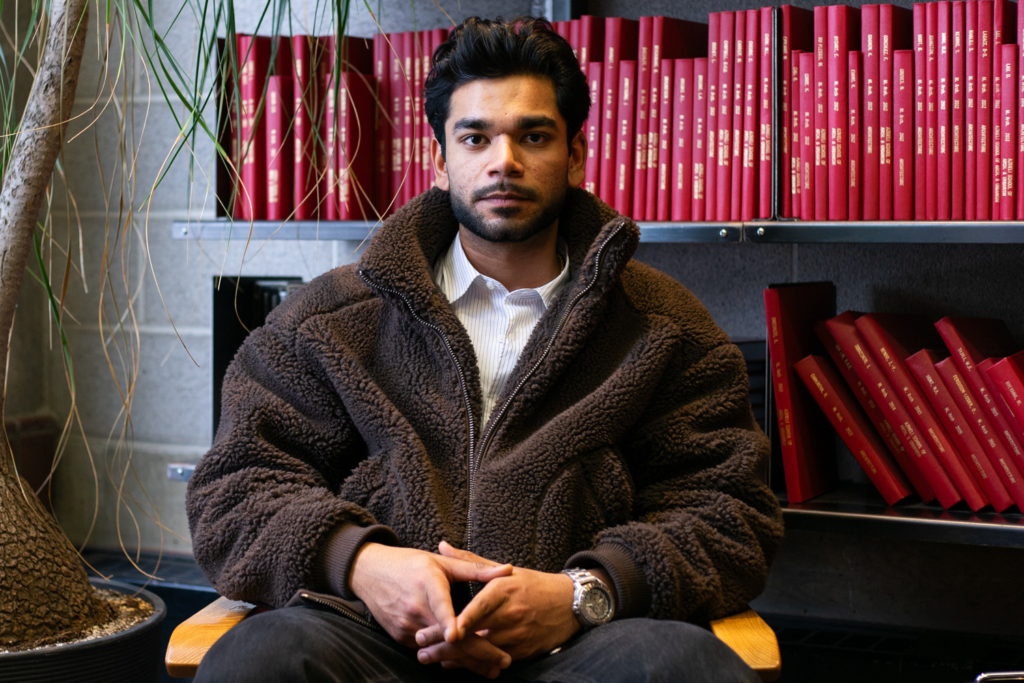
Aryan Singh; 4 demerit points down from 41
The CUSA appeals committee overturned three rulings against presidential candidate Aryan Singh, resulting in the demerit points issued dropping from 41 down to four. The decision on the four previous demerit points was not reviewed by the committee.
The committee dismissed complaint No. 5, saying the CRO’s findings are “unreasonable and unsupportable,” which was based on a video of an unidentified person campaigning on the fifth floor of the library.
In the video, the campaigner also “physically handled” the elector’s computer screen, which was visible while the elector cast her ballot at the campaigner’s request.
The CRO said both candidates were told ahead of time that anyone campaigning for them is their responsibility, and controls need to be put in place to prevent campaigning policy violations.
During the hearing, Singh presented evidence that he took steps to ensure that his campaigning team did adhere to the policies. The CRO said he did not have this information at the time of making his decision.
Singh also shared “genuine concerns” that the video was staged. The committee shared this concern, and said that the video had a “scripted air.” The CRO said he took that into consideration when making his decision.
The appeals committee said even if the video was authentic, they reject that responsibility falls on the candidate because of the way “campaign team” is defined in CUSA’s electoral code.
According to the code, a candidate’s “campaign team” refers to any person who is directly associated with the candidate, including those who engage “under the reasonable foresight of the candidate.”
The CRO believed the person in the video was under the reasonable foresight of Singh’s team, but the appeals committee rejected this, saying there was no provable connection between the candidate and the campaigner, since that connection was based on the campaigner mentioning Singh’s name and Singh electorally benefitting.
According to the decision, the CRO also did not address the steps taken by Singh to prevent this from occurring, which the appeals committee said was “significant omission in the evidence.”
Since the committee believes Singh was not responsible for the person, the entire complaint was dismissed, and the automatic appeal was upheld.
The other two decisions, No. 10 and No. 11, accused Singh of “campaigning in a prohibited area” and “interfering with the conduct of a free and fair election.”
The CRO said the “factual circumstances” in these two cases are identical to those in decisions No. 3 and No. 8, both of which are Heroux’s appeal decisions.
The automatic appeals were allowed, and the complaints were overturned.
In a statement provided to the Charlatan, Singh said that he “had full faith in the electoral process and trusted that the appeals committee would review the matter carefully and impartially.”
“I respect their decision and am grateful that they handled the process fairly, ensuring a rightful opportunity for representation,” he added.
Both candidates back in the running, remaining 4 demerit points each from pre-campaign violations
Now, neither candidate meets the threshold of 10 demerit points for disqualification.
“I am glad that both of us were able to overturn these false and vexatious complaints enough to be back in the race so it can be what it was always meant to be, a fair and free election,” Heroux said.
Last month, before the campaigning period had officially begun, both candidates were handed down four demerit points each for “minor electoral offences,” according to two CRO decisions. Neither of these decisions were sent to the appeals committee for review.
Heroux could not pursue an appeal on his CRO decision because he did not submit it within 72 hours of the decision.
“I still find this application of penalty disagreeable and add that the CRO ended up attaching this charge to everything and showed a clear pattern of behaviour in overcharging through this penalty,” Heroux said.
The release of CUSA’s general election results were delayed for the appeal review process. Results are set to be announced on Friday at 3 p.m. in Ollie’s Pub, according to a post on CUSA’s Instagram.
Featured graphic by Sara Mizannojehdehi/the Charlatan
This article, and all of the Charlatan’s work, is brought to you by an independent student newspaper dedicated to informing, uplifting and entertaining the Carleton University community. We are a levy-funded organization which plays a role in the broader, vibrant student culture on campus. By reading this article, you are supporting our efforts.