


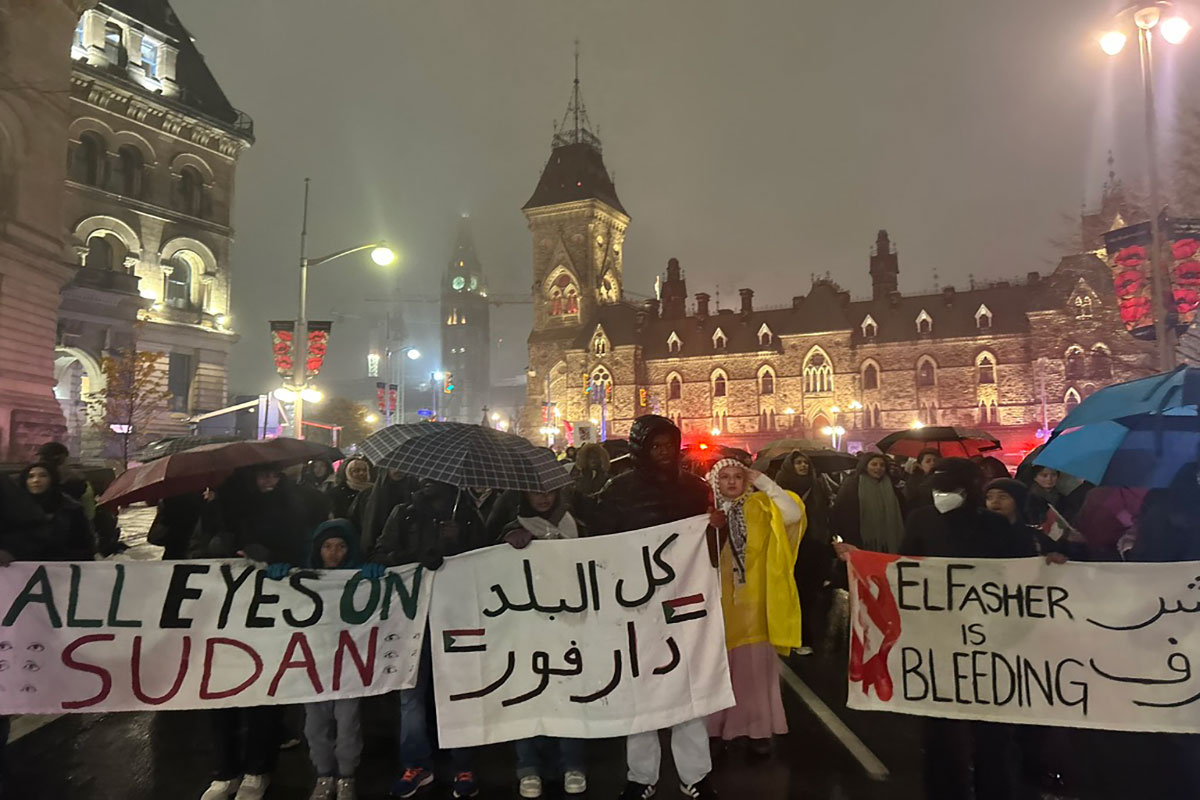
Through pelting rain and cold temperature, demonstrators calling attention to human rights violations in Sudan marched to Ottawa landmarks on Friday.
The demonstration started as a small group huddled in a doorway adjacent to city hall, sheltering from the pouring rain. Soon, dozens of people gathered by the Canadian Tribute to Human Rights monument in a sea of umbrellas and flags, as the crowd continued to grow through the night.
Student groups like the Sudanese Union Student Association, the Sudanese Canadian Association of Ottawa Youth Community, Carleton University Human Rights Society and Students for Justice in Palestine Carleton organized the march, dubbed “All Out for El-Fashir.”
“People can hear me, see me, and they can know I’m okay, that we exist,” said Omani Mosa, a Sudanese-Canadian who attended the march.
“We’re not alone. We’re here to raise awareness and speak up. We need the world to see you and hear about us, about what is happening back home.”
Worldwide attention turned to Sudan last week as reports of a massacre carried out by the Rapid Support Forces (RSF), a United Arab Emirates-backed militant group at war with the Sudanese government, hit the city of El-Fashir in the Darfur province.
On Tuesday, Yale University’s Humanitarian Research Lab released evidence of the RSF digging mass graves in the besieged city, where tens of thousands of people have been displaced.
Protestors called out what they referred to as Canada’s complicity in the atrocities, pointing to a Friday investigative report from the CBC, which found Canadian-built rifles in the hands of RSF fighters.
Scullion said the Carleton University Human Rights Society is calling on people to boycott products from the United Arab Emirates, like avoiding travel to Dubai or abstaining from buying gold products from the country.
Carlos Gama, a freelance videographer who attended the protest, said Canadians should be aware of the plight of the Sudanese people.
“There is no excuse to say that we didn’t know this was happening,” Gama said. “We have widespread coverage now.”
Gama compared the Canadian government’s inaction to its response to the Rwandan genocide in the 1990s.
“We look towards the past as a sort of a hubris, and think we are better than we used to be,” Gama said.
“Now, there’s always something that every person can do.”
__________________________________________________________________________________________
Featured image by Daniel Arnold/the Charlatan.