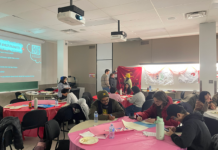


Columbia University Korean language professor Joowon Suh says there’s more to take away from K-pop than earworm tunes.
Earlier this month, Suh spoke to Carleton University students about what K-pop can teach us about Korean language and society, using the megastar group BTS as a case study.
Her talk explored language mixing and how fandoms engage with BTS content, expanding on her research related to Korean linguistics and discourse analysis.
The Charlatan sat down with Suh to discuss the language, culture and global impact of K-pop.
The Charlatan (TC): Can you tell us about your research and your journey into Korean linguistics?
Joowon Suh (JS): I studied applied linguistics with a focus on discourse analysis: how people communicate in conversation, online comments and any form of interaction. I taught Korean more than 20 years ago, and during that time I watched students change, especially as K-pop became a major reason people wanted to learn the language.
That shift drew me toward studying Korean data more seriously. My background in sociolinguistics and discourse analysis shaped how I look at pop culture and online interactions.
TC: Why did you choose BTS as the main case study for your research?
JS: I’ve always liked pop music, but BTS came through my students. In 2018, eight or nine students in my first-year Korean class were hardcore fans. Everything we talked about somehow connected to BTS. I didn’t know much about them, and my students were shocked. I started looking them up and one YouTube video led to another.
Suddenly, I was spending hours watching performances, reaction videos and fan interactions.
I realized this wasn’t just casual curiosity, but material worth researching. When I attended my first BTS conference in 2020, I saw researchers from cultural studies, gender studies, psychology, business and visual studies all examining BTS. That interdisciplinary energy inspired me to join them.
TC: What has your research revealed about how K-pop uses language to communicate globally?
JS: I’m fascinated by how K-pop artists communicate with international fans, even when their English is limited. Fans actively try to understand idols through tools like Google Translate and through bilingual fans who help interpret livestreams in real time.
On the artists’ side, social media platforms like Instagram provide auto-translation tools that make communication smoother.
English has also always appeared in Asian pop lyrics, but K-pop uses it in increasingly creative ways. Artists now rhyme English and Korean together, which requires listeners to understand both languages to fully appreciate the artistry. Some groups distort Korean sounds to resemble English, creating intentional double meanings. BTS sometimes leaves certain Korean phrases untranslated in English songs, inviting fans to look them up and deepen their connection.
TC: How do BTS and other K-pop groups use linguistic features like code-switching or mixing languages?
JS: Early K-pop simply inserted isolated English words into mostly Korean lyrics, but after 2010, with groups like Big Bang and 2NE1, English began to be used more purposefully.
Today, code-switching — shifting between languages within the same lyrics or sentence — is sophisticated. A Korean word and an English word can rhyme in a rap verse, or a Korean phrase may remain untranslated even in an English-dominant track.
This creates a multilingual soundscape where meaning depends on understanding both languages. Fans treat this as a creative puzzle, not a barrier.
TC: What can K-pop tell us about Korean society and cultural values?
JS: K-pop reflects both pride and tension within Korean society. Many Koreans are proud of the global influence of groups like BTS, but some feel distanced because the industry now targets global markets more than domestic ones.
The training system, historically strict and intense, reveals cultural values around hard work and discipline, but it is changing. Newer generations of idols have more freedom and input in their artistry. K-pop also interacts with gender norms — boy groups often adopt styles Western audiences see as feminine, reflecting Korea’s evolving and complex discussions around gender and sexuality.
TC: How do international fans engage with Korean lyrics?
JS: Fans learn slang, correct each other’s pronunciation of members’ Korean names and share interpretations. This creates a collaborative, multilingual fan culture. At the same time, as more groups release fully English songs, questions emerge about what makes K-pop “K-pop.” My students often say it’s not the language but the production style and artistic identity.
TC: Has anything surprised you in your research?
JS: I’m continually amazed by how multilingual and globally connected K-pop fandoms are. They don’t simply consume music, they teach each other language, analyze lyrics and bridge cultural gaps.
K-pop has become a dynamic site of language contact, shaping both Korean and English in the process.
This interview has been edited for length and clarity.
Featured image provided by Joowon Suh