
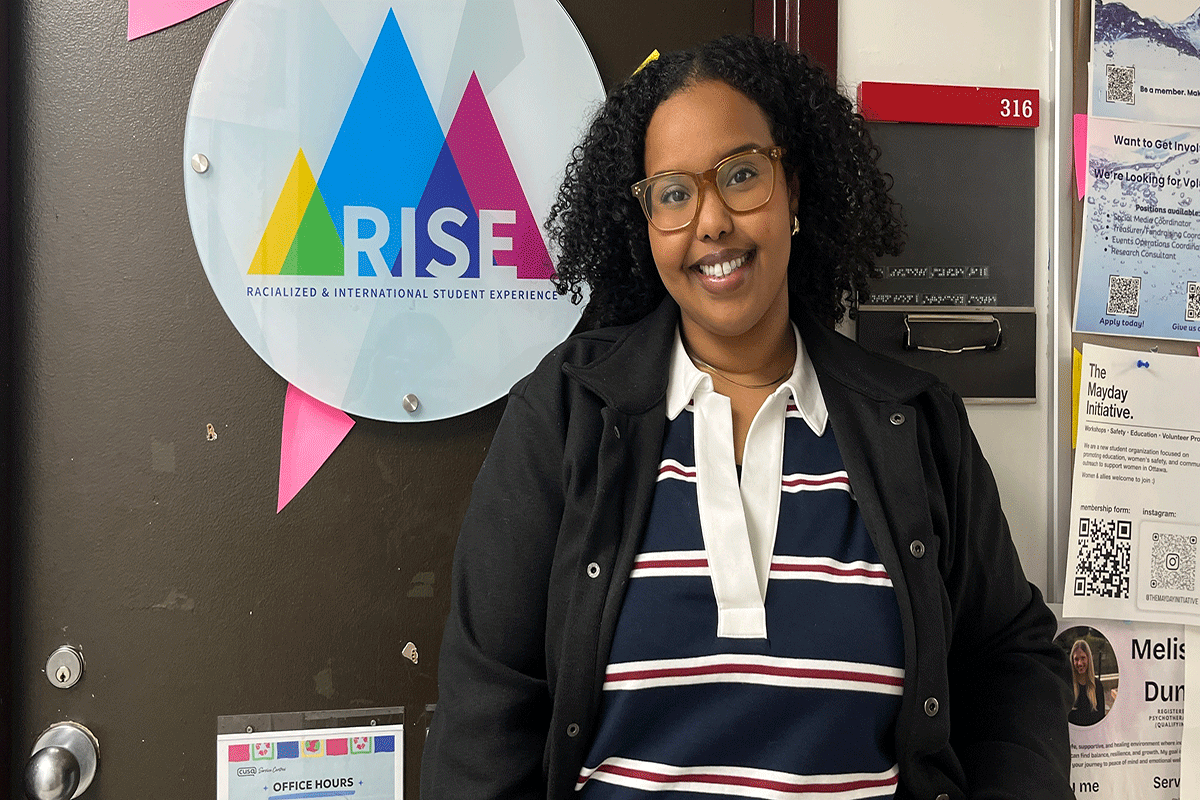
To Nora Elmi, a Somali-Canadian registered social worker and licensed mental health therapist, micro-aggressions are anything but miniscule.
Elmi, the founder of Elmi Counselling & Wellness Services, said that to the body, these subtle attacks feel all-consuming.
Elmi, who specializes in culturally affirming care and addressing the impacts of systemic oppression, intergenerational trauma and burnout, held an interactive workshop in late January at Carleton University, her alma mater.
The Charlatan sat down with Elmi to discuss her knowledge and experiences with micro-aggressions.
The Charlatan (TC): What are some common misconceptions about micro-aggressions?
Nora Elmi (NE): The number one misconception is people believe micro-aggressions don’t happen as much as they actually do, and that they’re overthinking.
Another one is people say, if it does happen, it wasn’t intentional. But if harm is felt, intention doesn’t matter. If harm is felt, it’s important to address it. So I always encourage people to find ways to communicate how you feel, if not directly, then through support.
Another one is that people might think that people are just too sensitive. But the reality is when things are happening repeatedly, and things are happening without validation, of course you’re going to feel some type of way about it.
TC: What led you to a career in social work and mental health?
NE: While I was struggling, I always had my finger on a pulse for the community. I was volunteering and involved in community programming. My mom is a single mom who raised four daughters. We relied a lot on community services and resources to get by, and I always appreciated the support.
But sometimes I just didn’t feel seen, understood and heard. And even from a young age, I was like, there needs to be more diversity up here. Everything kind of led back to social work. Representation is so key in our schools, in our homes, in our communities.
TC: What’s an instance of micro-aggression that stuck with you?
NE: Everything feels macro to me, because I’m just tired of it, and I can’t ignore it.
I remember working at a school in a local community as a youth worker, and I’m a melanated girl, so I think I genuinely just look young. I had a meeting with the principal. My hair is curly. I’m feeling nice. I walk into the office.
The lady at the front desk looks at me and she doesn’t say anything. Then she looks and goes, “Don’t you have class or something?” I was like, “No.” She said, “Why are you just standing here?” To which I then said, “Oh, I have a meeting with the principal.” She’s like, “No, you don’t. She’s in meetings, and she has meetings all day.”
Her whole thing was basically there’s no way this young Black woman can be meeting with the principal for whatever reason that’s justified.
Two seconds later, the principal comes out. She’s like, “Nora, oh my God, so nice to see you.” She gives me a huge hug. She’s like, “Girl, come inside my office. I was looking forward to meeting with you.”
And the lady’s jaw literally just dropped onto the floor.
TC: How did you feel in your body when you had this experience?
NE: I remember feeling so hot internally. My heartbeat was racing. I always want to say something, but in the name of professionalism, I was bottling a lot in. I remember I just felt internally caught. I almost had a shallow breath. But the whole time I was just telling myself it’s okay, she doesn’t know who you are. I was trying to maintain composure at the time, but I felt instant tension and activation in my body.
That, to me, is a sign that I was not okay.
TC: What advice do you have for people to be better able to detect micro-aggressions?
NE: If you think you felt something, do your best not to ignore it.
All these silent attacks on your body add up. Sometimes people are going to feel like, “Man, I have this low immune system,” or “I can’t get out of bed and I feel really down.” A lot of that is cumulative experiences of things like micro-aggression and experiencing blatant racism. So believe in yourself.
If you don’t want to believe yourself, believe your body.
This interview has been edited for length and clarity.
Featured image by Abyssinia Abebe/the Charlatan.
This article, and all of the Charlatan’s work, is brought to you by an independent student newspaper dedicated to informing, uplifting and entertaining the Carleton University community. We are a levy-funded organization which plays a role in the broader, vibrant student culture on campus. By reading this article, you are supporting our efforts.