

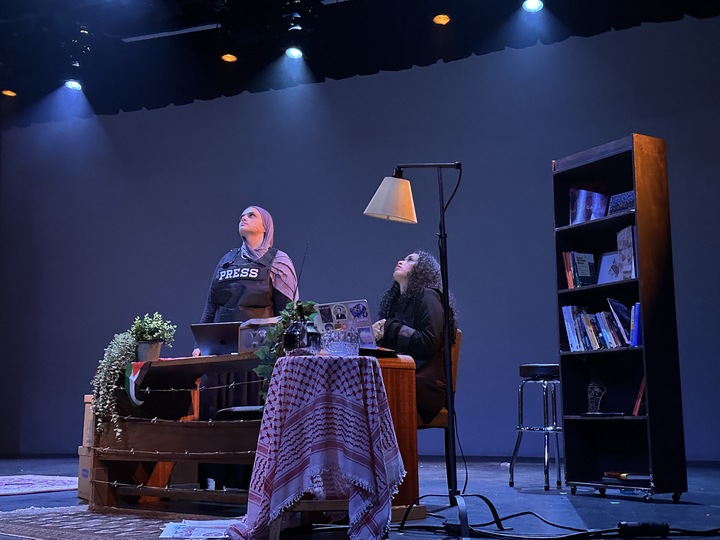
“You will not hear the missile that kills you.”
This phrase was repeated over and over again by performers and voice recordings in Carleton University’s Kailash Mital Theatre during an interactive performance of Living with Drones on Thursday.
The show by creative studio stitched!, is an interactive presentation combining documentary-style footage and personal narratives to tell stories about the traumatic impacts of Israel’s use of drones in Gaza.
The studio’s shows look to decolonize storytelling and shift journalistic practice, according to Sonya Fatah, the studio’s director and storyteller.
“We don’t call sources ‘sources’ — we call them story sharers,” Fatah said. “We centre the voices of communities that are marginalized over those that have power in a very clear way.”
During the show, Fatah played the part of “community gatherer,” giving viewers the opportunity to shout out thoughts or answers based on Fatah’s prompts about Gaza, history and where people get their news.
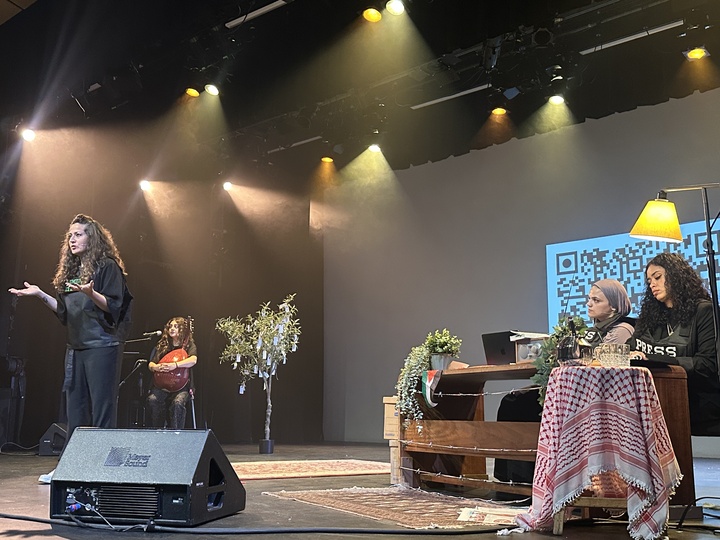
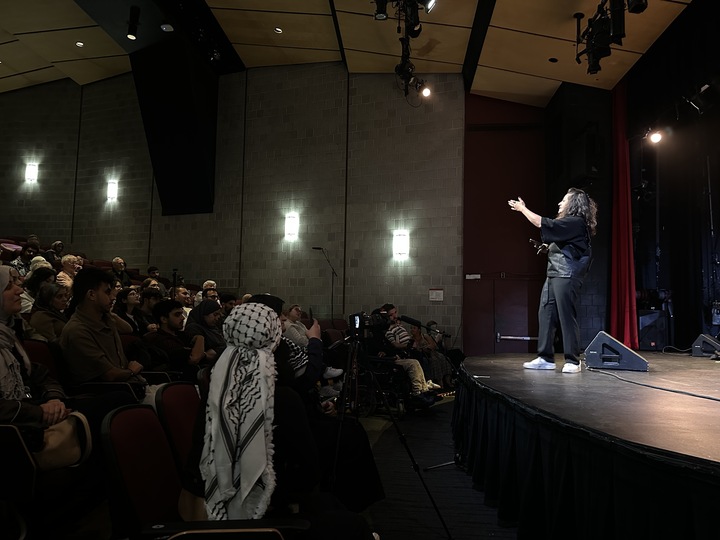
Fatah previously reported for the Toronto Star in Pakistan and Afghanistan during the War on Terror.
The idea for Living with Drones, she said, came from the personal “guilt” and “heaviness” she felt when she noticed that mainstream media and her own reporting failed to cover the United States’ use of drones throughout the war.
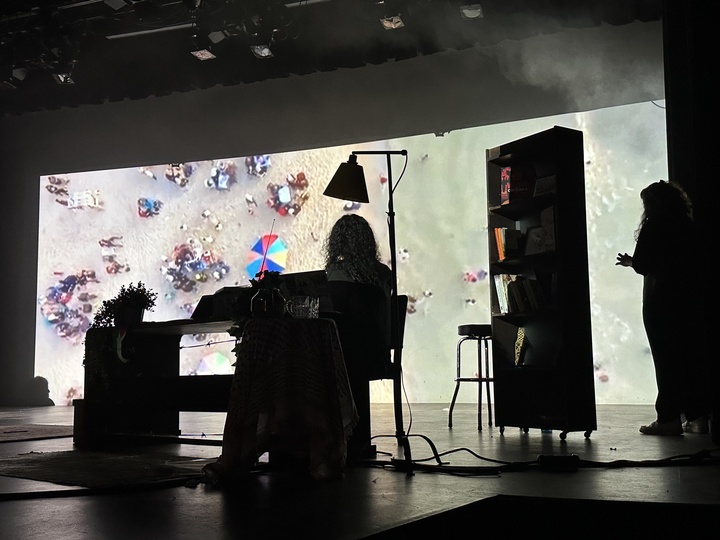
During the show, sounds of drones and bombs echoed around the theatre. Audience members saw clips of how Palestinians in Gaza coped with the constant noise, like teaching classrooms of children to harmonize and sing with the sounds of overhead drones.
Fatah came across diary narratives reflecting the impact of drones on residents in Gaza, further informing her idea for the show.
“We know drones are being used. They’re being used in Ukraine. They’re being used in many parts of the world,” she said. “In Gaza, it became very clear that this was a tool of oppression that has been used for a long time.”
Between documentary footage, storytellers Laila Hashem and Christin El-Kholy shared testimonies and perspectives of Sondos and Bashar, who currently live in Palestine and have experienced living under drones since they were children.
“It is extremely difficult to tell the story,” says Laila Hashem, storyteller with stitched!
“Every few months that we’re reporting the story, the story is constantly changing,” Hashem said. “This time especially was extremely hard just because the situation for Sondos and Bashar is worsening … they’re telling us, ‘We think we’re gonna die.’”
“It is extremely difficult to tell the story.”
Living with Drones uses Sondos and Bashar’s stories to create a timeline of events in Gaza since October 2023, including the bombing of Al Shifa Hospital, the death of Al Jazeera journalist Anas al-Sharif and the ongoing famine.
Hashem, a Toronto Metropolitan University journalism graduate, shared anecdotes and information from Bashar’s personal perspective in a diary format, while El-Kholy does the same for Sondos.
It was initially difficult for Hashem, who is also Palestinian, to share Bashar’s story because she said she felt like it “wasn’t her story to tell.”
“Despite how difficult it is, hearing from Bashar and Sondos and how much they see the recordings of our show [and] we tell them about it, they are just so happy and so grateful and so thankful,” Hashem said.
“That’s really what helps us get through this process.”
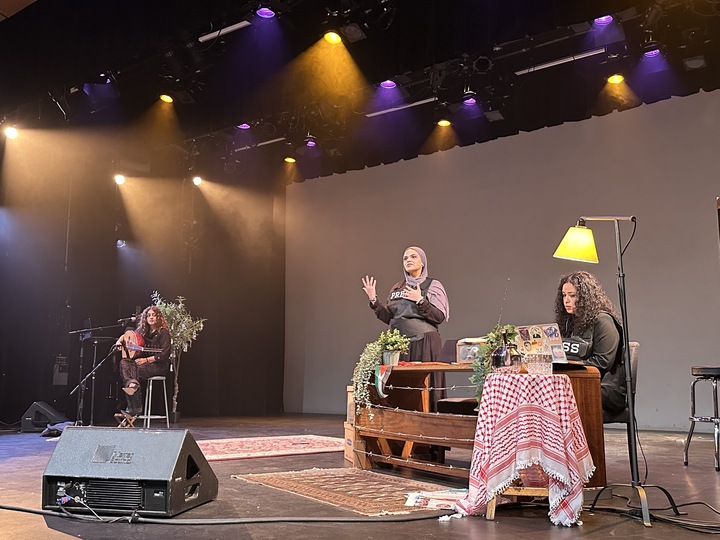
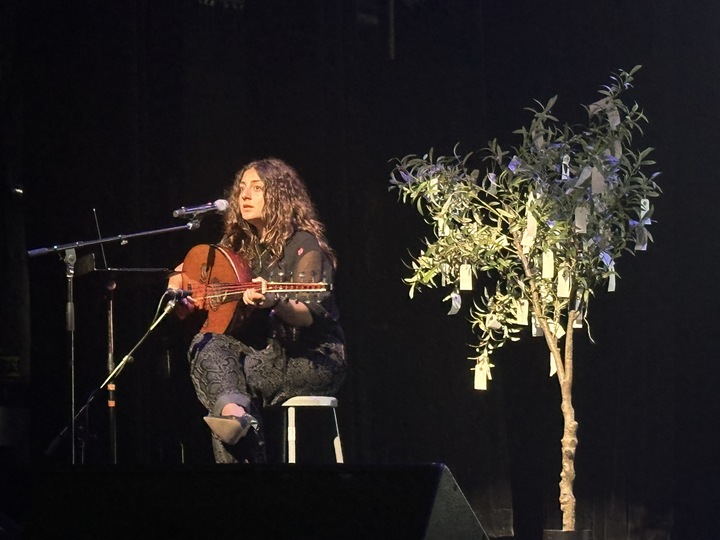
Between documentary clips and El-Kholy and Hashem’s narratives, musician Mariam Shak’a played the oud and sang traditional Palestinian folk songs, including “Yumma Mwel El Hawa.”
When she wasn’t singing, Shak’a strummed recognizable melodies to mark key points in Sondos and Bashar’s time under occupation, like “Happy Birthday” for Bashar’s birthday and “Jingle Bells” for Orthodox Christmas.
Accompanying visuals included a compilation of videos from Gaza’s beaches before the war and journalists killed in Gaza since the war began.
Visuals also revealed that Sondos and Bashar had recently gotten married, with their wedding photo displayed on-screen to thunderous applause.
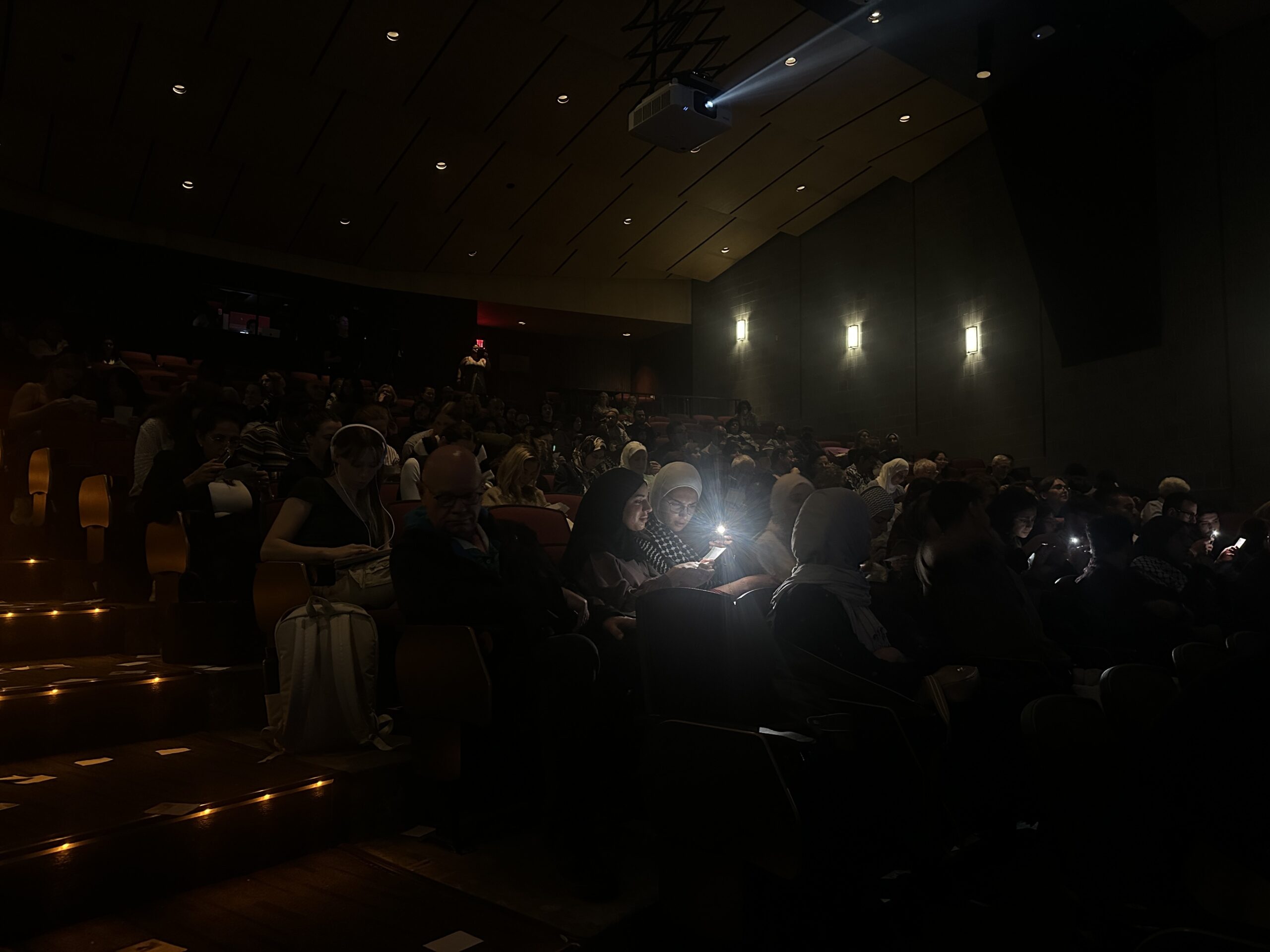
At one point in the second half of the show, tiny pamphlets of the Israeli Defence Forces’ evacuation notices dropped from the ceiling. Fatah urged the audience to read quickly because they “didn’t have much time,” simulating the abrupt reality of evacuations.
Fatah also invited audience members to share their own calls to action for Palestine. Attendees brought up community organizations and called for an end to the proposed “bubble bylaw” banning protest activity near certain institutions, as well as Carleton’s investment in companies tied to Israeli settlement activity on occupied Palestinian territory.
“This darkest time will end,” says a voice memo of Sondos in Palestine
Speaking particularly to journalism students, Fatah urged the audience to think about how they report on Palestine.
“I thought this was a great opportunity for me to get to know and be more aware of the situation,” said Mao Yasumura, a first-year Carleton journalism student. “I’m just shocked.”
The show concluded with a voice memo from Sondos which was sent to stitched! less than 24 hours before the performance, as United Nations agencies warned of escalating attacks, mass displacement and famine in Gaza.
“Everything is going to be the worst [it’s been],” Sondos said. “But I always remember myself, and Bashar always reminds me that everything will pass, and this darkest time will end.
“The sun will shine very soon and we will see the sunshine in our homes again.”
Featured image by Sophia Laporte/the Charlatan