


Fourteen-year-old Cassandra Harvey seemed like a “typical teen” in foster care: skipping school, staying out late and occasionally acting out.
Like many youths in foster care, Harvey said she struggled with finding stability, often feeling isolated and overlooked by the adults in her life. Spending time with friends offered a sense of belonging — including a 16-year-old who seemed kind and attentive.
But things quickly changed for Harvey when in 2013, casual hangouts with a man she met online turned into something more manipulative.
“He was grooming me, and eventually it turned into trafficking,” Harvey said.
What looked like ordinary teenage rebellion to an outsider was exploitation unfolding in plain sight.
Human trafficking often unfolds gradually through grooming, manipulation and online contact — making it difficult to recognize until exploitation is well underway. Experts, survivors and investigators say cases like Harvey’s reflect broader patterns across Canada, where victims are frequently young, isolated and targeted through digital platforms.
Most recently, Ottawa police charged 25-year-old Lochiel McCarthy with multiple offences, including trafficking in persons under 18, after a victim came forward alleging abuse between 2022 and 2024—a case that has raised broader concerns about human trafficking in the city.
Richard Schoeberl, a retired FBI agent from Tennessee, U.S., and founder of Hope for Justice, said human trafficking cases like these are not uncommon, with many involving grooming and manipulation long before exploitation becomes visible.
“A girl can grow up on the same street she’s being trafficked on,” Schoeberl said.
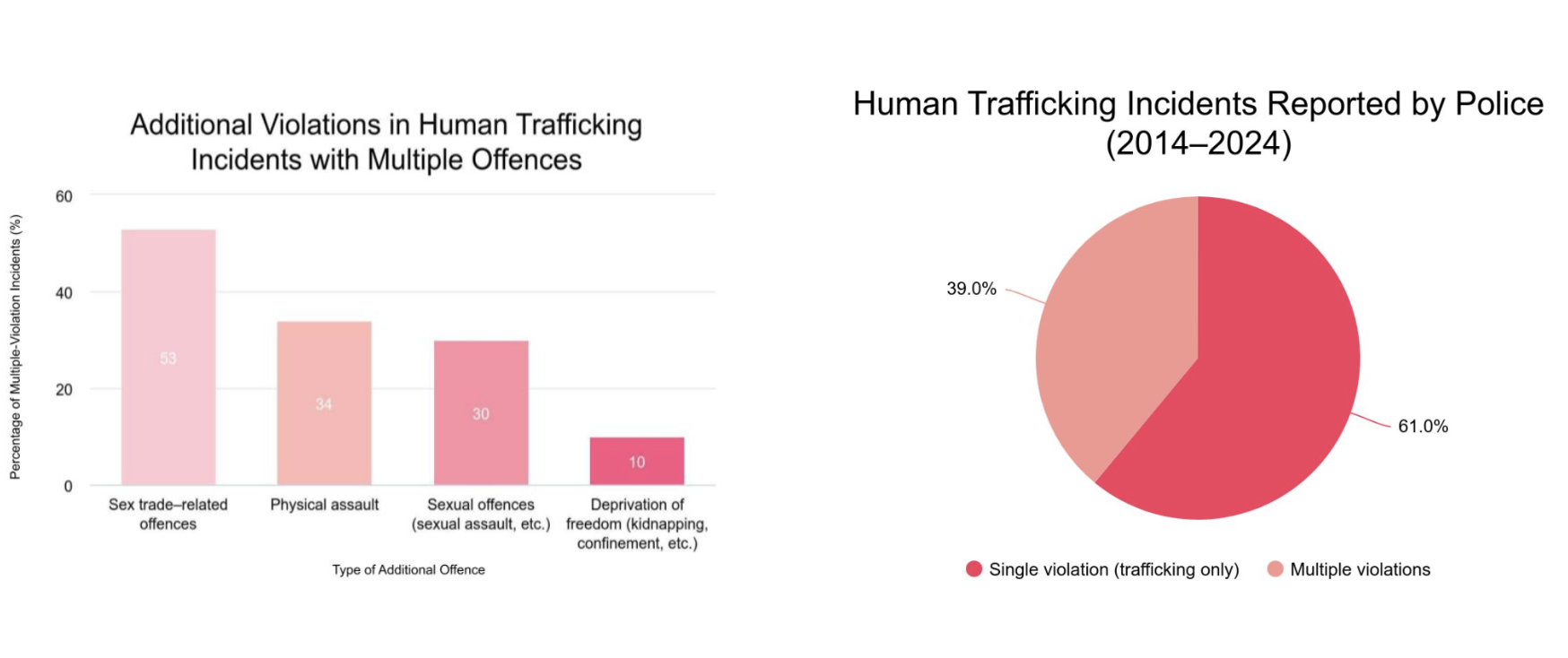
Women and girls represent 93 per cent of victims, with two-thirds of victims under 25 years of age. Between 2014 and 2024, 39 per cent of cases involved multiple offences, 53 per cent included sex trade–related crimes.
“You can only sell drugs once, but you can sell a person over and over again,” Schoeberl said, describing what he calls a “$250-billion-a-year business.”
National data show broader patterns of violence and exploitation often associated with human trafficking.
Early Warning Signs:
Human trafficking often goes unnoticed for years, in part because victims are manipulated and coerced.
“You can’t watch all of the people all of the time, right? And there’s not enough law enforcement out there to make that instant and common impact,” Schoeberl said.
Traffickers use force, fraud and psychological intimidation, sometimes setting up victims to commit crimes so they fear coming forward, according to Schoeberl.
“The trafficker will set them up to go meet a ‘John’ and they’ll send them with drugs,” Schoeberl said. Possible arrests for theft, assault, or other offences tied to trafficking further discourage victims from coming forward, according to Schoeberl.
“One of the things we often hear from survivors is that they didn’t realize what was happening to them when they were being trafficked,” said Ashley Franssen Tingley, director of the Canadian Centre to End Human Trafficking.
Franssen Tingley describes the Ottawa-based organization as a “backbone” group that shares anti-trafficking best practices and operates Canada’s confidential 24/7 national hotline.
The hotline supports victims, survivors and concerned family members by connecting them with community services and, if they choose, law enforcement.
According to Schoeberl, digital platforms have increasingly been a hub for traffickers, partly due to easy and widespread access.
During the early years of the COVID-19 pandemic, “60 per cent of trafficking victims had originally met their trafficker through an online platform,” Schoeberl said.
“One of my biggest concerns right now is what we’re seeing in the digital era, where we’re starting to see people who might be sextorted, and this sextortion is being used now as a control mechanism to traffic people.”
Gracia Younes, a human trafficking survivor and author of They Made A Monster, said punitive systems such as multiple foster placements, group homes and dismissive responses from schools can leave youth isolated and vulnerable.
These systemic pressures, combined with the emotional needs of youth, create openings for traffickers to exploit vulnerabilities.
“From an emotional and relational standpoint, you’re vulnerable to a trafficker who might promise you, ‘I’ll take care of you,’” said Dr. Kelly Kinnish, psychologist and director of the National Center on Child Trafficking.
The National Center on Child Trafficking, based at Georgia State University, develops resources and interventions that support children affected by sex and labour trafficking. The trauma-informed approach also works to support the professionals who serve the children.
Harvey echoed the sentiment, adding that foster children’s behaviour is often “dismissed.”
Early warning signs include restricted freedom, isolation, controlling behavior, unexplained possessions or money and frequent moves according to Ottawa human trafficking investigators.
Cindy Cybulski, an investigator with the Ottawa police’s human trafficking unit, said when youth are struggling to fulfil their own basic needs, attention can become a powerful lure.
“When you’re 12 or 13 and you’re not sure where your next meal is coming from, someone showing you attention might be the hook, line and sinker.”
Experts emphasize education and awareness among community members.
“The important thing is educating not only the children, but the parents on…how this happens, what it looks like,” Schoeberl said.
Technology has “accelerated trafficking,” Frassen-Tingley said, exploiting trust, curiosity and emotional need, while many victims remain hidden in plain sight.
Trafficking in plain sight:
Schoeberl shared a recent case that shows how quickly trafficking can take hold: a 16-year-old girl from Iran, newly immigrated to the U.S., ran from an abusive Texas home and accepted a ride to Louisiana from a truck driver who instead trafficked her across multiple states for over a year, posting ads and exploiting her in each city.
The abuse ended only when police stopped his overweight truck and found her in the back cab.
“Had that truck not been pulled over …who knows how long she would have been in the back of the cab,” Schoeberl said.
Over in Ottawa, Cybulski said investigations often begin indirectly because “There (are) a million different ways,” to traffic someone. Cases may start from a neighbor reporting a fight at an Airbnb, hotel records, surveillance footage, banking records or digital warrants she said.
Whenever possible, investigations are survivor-centered.
“Let the survivor drive the bus throughout the entire investigation and the court process,” she said.
Digital exploitation and online grooming:
For most minors who are victimized, exploitation begins online, according to James Meadway, a private investigator from the Council of Professional Investigators Ontario.
The CPIO supports private investigators across the province by providing training, collaboration tools, networking opportunities, and advocacy for legislative change, while promoting recognition of its members as investigative professionals.
Meadway said predators often operate within Canada to avoid detection.
“Minors being snagged on the internet is probably the single biggest area,” he said. “The groups that are best at remaining secretive and maintaining their internal security are the ones that don’t get caught.”
Social media has transformed trafficking. Harvey shared her experience:
“A lot of it has to do with social media. I met one of my traffickers on Tinder … I was very young, and because I was in foster care, I had different vulnerabilities. I was always looking for attention, especially male attention.”
Schoeberl said an interview with a person incarcerated for exploitation of a minor gave insight into how traffickers operate online.
The individual told Scheberl that he “would take their usernames, look at their profiles, determine their likes and dislikes … and start building rapport almost instantaneously.”
Frassen-Tingley said “technology has allowed traffickers to expand their operations to be more sophisticated, using AI and crypto and other types of technology as a way to facilitate the trafficking.”
Bringing justice:
The justice system can be re-traumatizing for survivors, according to Harvey.
She described the court process as being “very daunting,” adding survivors have little to no control around the circumstances of their trial.
Investigators, however, stressed the legal complexities at play. Cybulski explained police require survivor consent to proceed and focus on building trust, even if forming the rapport takes time.
For Harvey, accountability means more than prison time. “I wanted a restorative justice approach,” she said, arguing lasting change requires understanding the cycles of exploitation.
Prevention and community support:
Schoeberl raises awareness through educational webinars. “I’m a firm believer that there’s a trafficker, and there’s your abductor. They’re two different people.” Schoeberl said.
Cynthia Bland, CEO of Voice Found, emphasizes survivor-led care: “It’s all about their choices … They are in charge.”
She says the organization’s Hope Found Project focuses on the critical first stage after someone leaves a trafficking situation — helping survivors stabilize and access immediate support.
The program connects people with peer support workers with lived experience, case management, housing assistance and health care while they begin rebuilding their lives.
However she also believes “there’s no time limit, because everybody’s path and journey is different…It is really focussed on the emergency, exiting from a trafficking situation and really getting people stabilized.”
Frassen-Tingley pointed to broader solutions: funded after-school programs, stable housing and real opportunities to reduce the vulnerabilities traffickers exploit.
But official statistics tell only part of the story.
Meadway calls underreporting “endemic” and Bland noted victims are getting younger and facing increasing violence.
“The grooming process is entrenchment. Once they are entrenched, we’re finding there is more violence in the controlling… we’re just seeing a lot more violence,” Bland says. “Because we have a health clinic, we get the whole picture, and I do know it is increasing.”
Grooming often begins subtly, with traffickers posing as friends or romantic partners. Once control is established, violence frequently escalates: choking, strangulation and assault are common, as Cybulski explains. And while not every case is violent, it is “very, very often… (that) there are serious injuries and hospitalization.”
Featured image provided by Cassandra Harvey
This article, and all of the Charlatan’s work, is brought to you by an independent student newspaper dedicated to informing, uplifting and entertaining the Carleton University community. We are a levy-funded organization which plays a role in the broader, vibrant student culture on campus. By reading this article, you are supporting our efforts.