The Carleton University Students’ Association council elected three new vice-presidents in the second of its third annual members’ meetings on Sunday.
The candidates for the three positions — vice-president (student life), vice-president (student issues) and vice-president (internal) — responded to questions from councillors, each making their bid for the position.
The annual members’ meetings are council meetings for large agenda items, like ratifying election results, approving the budget and electing vice-presidents. Both outgoing and incoming CUSA councillors generally attend.
A total of 24 ballots were cast in this year’s vice-presidential election, said Basit Ur Rehman, CUSA’s chief returning officer, down from last year’s 34.
Vice-president (student life): Georgia Anderson
The CUSA council elected Georgia Anderson, a second-year linguistics student, as the new vice-president (student life). Anderson received 15 of 24 votes in the fourth round of balloting.
The position handles CUSA’s initiatives and programming, like Frosh week. The role’s salary is an estimated $43,000. This year, there were four candidates on the ballot, with three delivering speeches.
Anderson campaigned to reboot CUSA’s newsletter to better engage the student body and spoke again about that initiative at Sunday’s debate.
“Awareness for CUSA in general needs to be increased,” she said. “I would try to make CUSA a welcoming space and a space where students can understand why they’re important.”
In response to a question about the single-digit voter turnout in the presidential election, Anderson said she hopes her monthly newsletter will bridge concerns students have about the students’ association.
“The first email from CUSA they get won’t be the presidential election ballot,” she said. “Once March comes, students will understand what CUSA is.”
Anderson said her lack of involvement in the student union is an asset because she can relate with students on where potential service gaps may lie.
The question period for this section was delayed by arguments from councillors about how many questions each round should get, how many follow-ups questions should get and whether a time limit should be imposed. The debate was more than two hours long.
Vice-president (student issues): Nathan Harlan
Nathan Harlan, a fourth-year political science student, will be the new vice-president (student issues) of CUSA. Harlan received 15 of 24 votes in two rounds of balloting.
Harlan said CUSA will be his only priority in his upcoming term, adding he’ll reduce his courseload to make good on that promise.
The position advocates for students across campus to address academic and social issues and has an estimated salary of $43,000. This year, three candidates delivered speeches.
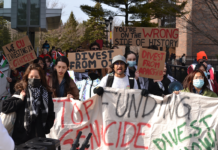
Harlan said he wants CUSA to be an active stakeholder on university issues, not just a spectator. He said he would regularly meet with members on Carleton’s Board of Governors to leverage student’s demands on divestment, as well as the incoming OSAP changes and two per cent tuition increase.
“Our goal is to change policy [and] to improve the lives of students,” he said. “Divestment should not be a hard thing for this university to do.”
Harlan also said he would ensure a smooth transition when taking over CUSA’s marquee Breakfast Club, a weekly initiative started this year that provides students with free food.
“I believe it’s one of CUSA’s most successful programs this year,” he said. “I definitely would want to make sure it continues.”
Vice-president (internal): Amy Kopytskiy
Amy Kopytskiy, the current speaker of council, will be the next vice-president (internal) of CUSA with 22 of 24 votes in two rounds of balloting.
The vice-president (internal) oversees student governance, clubs and council administration and has an estimated salary of $43,000.
Kopytskiy said she would prioritize improving accountability and communication within CUSA governance.
She added she would introduce a new role called the “accountability officer,” inspired by a similar role at the Carleton Student Engineering Society. The officer would be responsible for collecting and sharing feedback about CUSA leadership, including anonymous feedback from councillors that would be shared with executives.
Kopytskiy added that CUSA could also introduce an online submission form for students to share ideas or concerns.
Kopytskiy said she would aim to collaborate more closely with club leaders and address issues related to club funding processes. She added she wants to reduce communication barriers for club leaders and executives who want to ask the students’ association questions.
Kopytskiy also said she wants greater transparency around CUSA’s board of directors and its decisions.
“We have a little bit of an untransparent board, recently,” she said, adding that there should be a “good line of communication” between the board and council.
Motion to condemn war on Iran
Beyond the vice-presidential elections, CUSA council also unanimously passed a motion condemning the United States and Israel’s war on Iran.
Mohamad El Fitori said he wrote the motion in collaboration with Nir Hagigi*, the co-president of the Carleton University Human Rights Society.
“We have seen before what these types of conflicts entail,” El Fitori said. “At this time, this does not seem like a movement created by Iranian society. It is actually directly harming Iranians.”
The motion also calls on the university to divest from companies it says are “complicit in war crimes,” arguing that universities are not neutral institutions in global conflicts.
“Through financial investments, research partnerships with military and security industries and the suppression of student advocacy, Carleton has shamefully positioned itself alongside institutions that benefit from militarism while attempting to silence those who challenge it,” the motion charges.
The university has previously said that it is committed to responsible investment practices, as established by its responsible investing policy.
CUSA council’s motion concluded by mourning the lives lost across the region and saying it opposes what it describes as the “normalization of endless war.”
Editor’s Note: This article has been updated to correct the spelling of Amy Kopytskiy’s name. The Charlatan regrets the error. This article was last updated on March 12, 2026 to reflect this change.
*Nir Hagigi has previously contributed to the Charlatan
Featured graphic by Alisha Velji/the Charlatan.
This article, and all of the Charlatan’s work, is brought to you by an independent student newspaper dedicated to informing, uplifting and entertaining the Carleton University community. We are a levy-funded organization which plays a role in the broader, vibrant student culture on campus. By reading this article, you are supporting our efforts.