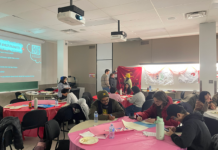


The two candidates for the Carleton University Students’ Association presidential election faced off in the Nideyinàn Galleria on Wednesday, debating how to optimize the student union’s finances, the controversial institutional impartiality policy and pro-Palestinian advocacy concerns.
The Charlatan moderated the evening debate, drawing on questions submitted by the campus community about CUSA finances, advocacy, campus life and more.
Aryan Singh, a systems and computer engineering student, said his platforms target commuter students, marginalized community members and overburdened club executives. Singh’s plans include “fairer” funding for small clubs on campus, more advisory committees for underrepresented minority groups and a small-scale emergency rent subsidy for students.
Maxwell Heroux, a political science student, advocated for streamlining existing CUSA policies and procedures, with an emphasis on bettering transparency, approachability and accountability for the student union. Heroux’s platforms include frequent and plain-language financial updates; simplifying CUSA operations and club procedures; and more “proactive” use of the student union’s accessibility fund of more than $500,000.
Read more of the Charlatan’s 2026 CUSA election coverage:
- 2026 CUSA election: Here’s what Carleton students need to know
- BREAKING: Prospective CUSA presidential candidate violates election rules before campaigning begins, report finds
- Second CUSA presidential candidate violates election rules, report finds
Heroux said he decided to run for the top student union job after working at the CUSA-run Ollie’s Pub & Patio, then getting further and further involved in student governance and recognizing issues he believes he can fix. Heroux, a CUSA councillor, added he is heavily involved in other campus organizations, so he would look to spend as much time in the CUSA office as possible to hear from students directly.
Singh, who is also a CUSA councillor, said the most exciting part of securing the presidency would be making his parents in India proud, joking that they’re “more excited” than he is about the campaign. He said his varied interests — including poetry, rap music and the gym — have expanded his worldview and make him a strong critical thinker.
Finance
Heroux said his top financial priority is an in-depth review of CUSA’s finances, including of struggling business The Wing — which shuttered without a public explanation from the board, he said — and Ollie’s.
“Haven is a casualty of that lack of financial review,” he said of the CUSA-run bookstore and cafe that shut its doors at the end of 2024 amid financial deficits.
Heroux added the student union must ensure funds don’t go unused or underutilized, and students should be able to easily understand where their levies are going through regular and easily digestible public updates.
“The only way you can get a clear answer about CUSA’s finances is through literally interviewing half the executive,” he said. “That shouldn’t be the way it works.”
Singh said he would also look to increase transparency, adding he would avoid monthly financial reports that could overburden staff at CUSA-run businesses. Singh also called for more data collection, including a closer look at businesses that are exceeding their projected spending and a more competitive strategy to source ingredients.
Singh said data collection would allow CUSA-run businesses to take a closer look at unpopular times to patronize campus businesses and which menu items are the least profitable.
Advocacy and campus life
Heroux said he believes pro-Palestinian protests on campus are overpoliced compared to other demonstrations, adding CUSA should work with the university to ensure campus security is protecting protestors. Heroux is also a member of CUSA’s divestment subcommittee and said he would continue to pressure Carleton to divest from companies with ties to Israel as CUSA president.
Heroux added he is firmly against Carleton’s institutional impartiality policy, which he said prevents faculties from assisting students with advocacy issues to their full capacity.
Singh agreed that CUSA and the university must act on anti-Arab and ant-Palestinian discrimination, adding he sees a “good and bright future” for divestment advocacy in the student union.
Heroux also said he would work with academic campus organizations and Carleton to ensure artificial intelligence is being used properly at the university. He said AI “is in no position” to make management, judgement, course material or marking decisions.”
“We shouldn’t be using it in the ways the university is suggesting.”
Singh said “turning our heads away” from AI is not an option, so he would focus on academic reforms to help students learn from AI without cheating.
Singh added CUSA council focuses on representation by faculty instead of representation of marginalized communities, such as Indigenous Peoples. He said CUSA’s service centres are a good start, but the student union should take a more intersectional approach — including collaboration with other campus organizations — to accommodate students who are part of multiple marginalized communities.
Committee-based representation for marginalized communities means “CUSA could be their microphone,” he said.
Also among Singh’s key platform points is a plan to create a small-scale emergency rent subsidy for students who urgently need to attend family emergencies, which Singh said is a critical initiative in this geopolitical moment. He said he would find the money for the subsidy initiative in CUSA’s budget without using a levy or cutting other services.
Heroux suggested CUSA should streamline club processes and procedures to make them more accessible. The website needs an overhaul, so students don’t have to go on a “wild goose chase to find out where to ask for a bank letter,” he said with a laugh.
“Campus life effectively dies without the clubs,” Heroux added, saying that fixing basic systems and establishing clear timelines for club operations would allow students to hold CUSA to account.
Singh said he would look to make funding fairer for smaller clubs and introduce an online portal that all clubs could use to apply for funding and carry out administrative work.
Featured image by Simon McKeown.
This article, and all of the Charlatan’s work, is brought to you by an independent student newspaper dedicated to informing, uplifting and entertaining the Carleton University community. We are a levy-funded organization which plays a role in the broader, vibrant student culture on campus. By reading this article, you are supporting our efforts.