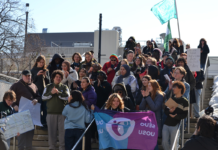


Carleton University’s Board of Governors voted to approve the controversial Institutional Impartiality Policy in a meeting Tuesday — prompting student protesters to lob snowballs at the meeting room’s covered windows.
The policy will prohibit academic or administrative departments from making statements on political issues and prohibit staff from making statements that are interpreted as being on behalf of the university.
Carleton has received criticism for the policy, with student groups, faculty and unions calling on the university to withdraw the policy from consideration, citing potential threats to free speech and academic freedom on campus.
Black screens were set up alongside the east side of the Richcraft Hall meeting room, blocking the view through windows looking out onto protesters chanting against the policy.
The screens were “sound barriers,” allowing board members to focus on the meeting, according to board chair Beth Creary.
Even with the screens, protesters chanting through megaphones could be heard in the meeting room as university president Wisdom Tettey introduced the policy for approval.
“The policy makes one principle clear,” Tettey said. “Carleton University does not endorse political or parties of positions as an institution.”
The policy would not prevent the university from defending academic freedom, human rights and inclusivity, Tettey said, adding that Carleton faculty and staff retain the right to research, teach, publish and speak about political issues.
“It is not an overreach or an unnecessary addition as some might claim,” Tettey said.
Undergraduate student representative Allan Buri asked the board to postpone the vote on the policy to the next Board of Governors meeting scheduled for March. The university should conduct additional consultation, Buri said, citing community concerns about the policy and its potential impacts.
“There is no pressing reason for why this policy must be approved today,” he said.
“Instead, there are several compelling reasons why the most responsible option is to table this motion until it can be amended with an improved policy and better consultation.”
Buri said the policy has “ambiguities” and urged the board to take more time to consider community feedback.
“Nobody that has spoken to us has been able to identify a statement from a department that would violate this policy,” Buri said.
“I asked several times for an example of a statement that would violate (the policy), and I was not given one.”
Kevin Graham, the Senate’s representative to the board, said that while the policy has a place at the university, it hasn’t been properly communicated.
“I’m not sure that the underlying reasons … have really been communicated effectively to justify the timing and purpose of the policy,” Graham said.
The version of the policy presented to the board for approval had “significant changes” released publicly just eight days ago, he added. Community members wouldn’t have had enough time to understand and respond to the proposal, he said.
“I’m not able to understand the urgency of trying to push this through,” Graham said.
The community consultation on the policy was extended by a week from Oct. 31, Tettey said, and received more than 300 responses with feedback. The policy was updated with “significant revisions to clarify intent and to strengthen language supporting academic freedom,” he said.
Buri’s motion to postpone the vote on the policy failed, with six votes for and 18 votes against.
Members of the board then voted on the policy itself, which passed.
After the approval, the chanting outside of the room immediately grew louder and the sound of snow could be heard as it was thrown at the east windows and walls.
Tettey said the university has a plan to engage with the community through “various avenues” and answer questions about the policy.
“We continue to encourage the community to look at the policy as opposed to hearing it secondhand,” Tettey said.
Featured graphic by Sara Mizannojehdehi/The Charlatan
Editor’s note: This story has been updated to clarify a comment made by undergraduate student representative Allan Buri. The Charlatan regrets the error.