

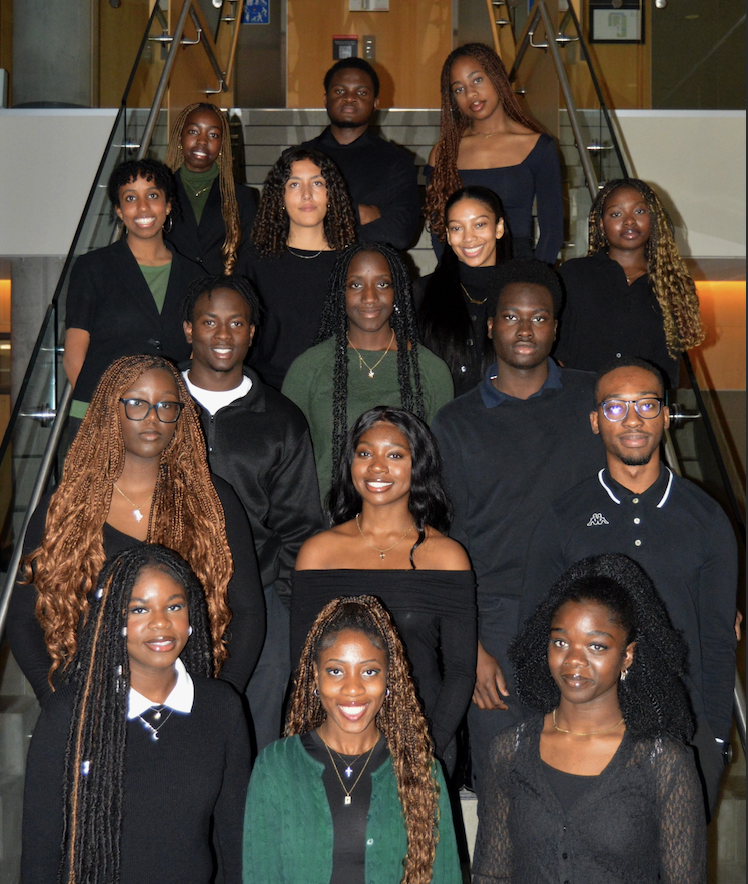
Every engineer knows the sacrifices required to make it to the iron ring ceremony. But for Black engineering students aiming to achieve the same goal, there’s often another set of ladders to climb.
For Jordyn Bellamy, a second-year computer systems engineering student at Carleton University, imposter syndrome is one of them.
“It was hard to come to terms with being the only one in my class that looks like me. It’s like a deep anxiety: ‘Am I good enough?’” Bellamy said, adding she has heard similar experiences from her friends in the program.
Bellamy and her peers at Carleton are not the only ones experiencing imposter syndrome. It’s a nation-wide, industry-wide phenomenon that has hit Black students particularly hard, according to 2023 research investigating mental health factors to increase participation of Black students in science, engineering and medicine.
The research found imposter syndrome is especially harm Black students who, in addition to the self-doubt other students feel, are targets of implicit or explicit bias in addition to the self-doubt that other students feel.
Bellamy, who is also the vice-president (communications) for Carleton’s National Society of Black Engineers, said she used her personal experiences to come up with a simple technique to help others overcome imposter syndrome.
There’s a simple trick to staying grounded when imposter syndrome creeps up, Bellamy wrote in an Instagram post on the Black engineering society’s Carleton page. The key is to “Remind, Reinforce and Reward,” she said.
Bellamy added the system allows students to remind themselves of past successes, reinforce healthy habits for future success and celebrate the small wins by rewarding oneself.
National Society of Black Engineers beyond Carleton
Over at Queen’s University, Erhowvosere “Sere” Otubu and Kaykay Akpama, who are the Queen’s National Society of Black Engineers co-presidents, said they’ve witnessed imposter syndrome among their peers.
Otubu, who is in his final year of computer engineering at Queen’s, said he has experienced imposter syndrome since his first year.
“I feel like it comes and goes in waves depending on the season,” he said, adding that he experienced the brunt of it in his first year.
The feeling crept back as he prepared his internship applications during his third year.
“I was getting a lot of rejections, or I was being ghosted a lot, and it made me doubt my skills as a computer engineer and someone who is interested in software development,” he said.
What ‘Black excellence’ means to engineering students
Rodney Oghinan, a third-year mechanical engineering student at Carleton, said the biggest source of his imposter syndrome stems from the fact that he still hasn’t had a Black professor.
Oghinan added he has consequently questioned whether there are many people with his skin tone in higher-level positions.
For Bellamy, unintentional comparison and unspoken parental pressure are two major aspects that feed into imposter syndrome.
“It’s common among me and my friends, where your parents have sacrificed a lot for you to get here — just so that they could afford to send you to school,” Bellamy said. “I think a lot of Black students feel like they owe it to their parents to make up for it.”
The “Black excellence” mindset doesn’t resonate with the entire Black community, but Bellamy said it’s prevalent in the engineering industry.
“Yes, I’m passing the classes. Yes, I’m working hard. Yes, I know that I’m smart,” Bellamy said, adding that more privileged students’ achievements often overshadow her own successes.
Akpama, who leads the Queen’s National Society of Black Engineers with Otubu, said the pressure of Black excellence is the feeling that you aren’t just representing yourself — but the entire community.
“In a challenging industry like engineering, there’s an unspoken weight to be twice as good to be seen as equal,” she said. As a result, “It makes setbacks seem bigger, as if a personal loss is a reflection of the capability of the Black community,” she said.
Akpama said her sense of self as a Black woman has become much more defined since starting university.
Entering the engineering community at Queen’s made her “more acutely aware of my identity … Not necessarily through negative interactions, but through the realization that my lived experience even as a student in the engineering department is quite different from that of my peers.”
Akpama said being one of few Black women in these spaces has actually made her prouder of her identity.
“It has shifted my perspective from just being a student to being a Black woman in engineering, which brings a unique sense of purpose and pride to my work.”
Working ‘twice as hard just to get half as far’
For Bellamy, Black engineering students often have to work “twice as hard just to get half as far.”
“It may or may not be true, but a lot of people say that. And it feels true sometimes. It feels like when looking at your other peers, you are the one that’s almost disregarded or diminished, so you have to be always on point.”
Otubu echoed that feeling. “It’s not that everybody else doesn’t work hard,” he said. “But I feel like I’ve had to work really hard to achieve what I want and also make a name for myself.”
Otubu said this is partially due to prejudices about the Black community within predominantly white spaces.
“‘Oh, he’s probably here because he’s Black, and they needed some representation in the faculty’ or ‘He’s probably just here because of some type of special treatment,’ or whatever it is.”
“I’m the first generation of student [within my family],” he said. “I don’t have a lot of connections in the industry, for example, that can really help me when it comes to propelling my career,” Otubu said.
Meanwhile, Otubu said some people are fortunate enough to have those connections through family members. “I know a lot of other students who look like me that didn’t have those connections or opportunities — because we’re starting to make them now,” he said.
‘Representation shouldn’t be controversial’
While he has often felt these barriers have held him back, Otubu said he’s also “seen a lot of perseverance and determination” in his community.
For Otubu, the Queen’s National Society of Black Engineers has been a space for networking and support systems.
“In one way or another, a lot of us kind of experience the same things when it comes to our professional journey.”
Oghinan said being a part of National Society of Black Engineers at Carleton has made him feel more in tune with campus life.
Carleton’s chapter of the society only started this year, said Oghinan, who currently serves as the club’s finance minister. Before that, a sense of community felt scarce for Oghinan.
“Before (the Carleton chapter), there wasn’t really any community specifically for Black students,” Oghinan said.
“There was a disconnect there. (I was) trying to get involved in the engineering society, but there really isn’t anything specifically for me.”
Bellamy said people commonly underestimate the importance of diversity, equity and inclusion to the Black community.
“Things are getting scarier, honestly, because we don’t want to be seen as just a DEI hire, even if we literally were hired based on merit,” Bellamy said. “People don’t really see it that way.”
Sharing resources, even as simple as the “Remind, Reinforce, Reward” technique to deal with imposter syndrome, encourages a supportive environment among Black engineering students, Bellamy said.
“It was something I created on the spot, but the topic was very real to me,” Bellamy said. “I’ve dealt with imposter syndrome since high school.”
Bellamy said her ultimate hope is to spread awareness.
“These are conversations that we can all have candidly without feeling like we’re blaming somebody. Representation shouldn’t be that controversial.”
“I don’t think that we need to force diversity, but (I want us to) spread awareness to Black students and non-Black students and say: ‘Hey, you’re actually wanted in these clubs.
“We’re trying, and we care.’”
Featured image provided by Jordyn Bellamy