

When Patrick Stevens worked as a school custodian at the start of 2025, he liked to draw a simple wizard on the whiteboard of each classroom he cleaned.
Sketching a pointed wizard hat, scraggly eyes and a coarse beard that covers a shapeless torso, he operated anonymously and without meaning.
This simple sorcerer was something Stevens began sketching in his notebook before perfecting on classroom whiteboards. After 20 pages of revisions Woglin was born.
To his surprise, Stevens returned to work one day to see “His name is Fili” written under one of his dry-erase Woglins. This was the first time Stevens’s public art started a dialogue — but it wouldn’t be the last.
With QR codes and other digital tools like augmented reality (AR), some Ottawa artists have found a new way to communicate through art.
As an artist and recent graduate of Carleton University’s information technology program, Stevens always wanted to bridge his two interests through an interactive art project.
“As an artist, I see a blank canvas everywhere.” – Patrick Stevens
With the help of a Sharpie, Woglins started appearing on streets across the Glebe and Old Ottawa South.
“As an artist, I see a blank canvas everywhere,” Stevens said. “Anytime I leave a store and see a lamppost or something, I’ll try to draw one there.”
Stevens said he tagged more than150 wizards across Ottawa in the span of three months, mainly in pedestrian-concentrated areas like Lansdowne and along the Rideau Canal.
“Woglin” quickly became a word-of-mouth sensation, and Stevens wanted a way to keep the conversation flowing.
“People like the Woglin, and people trust the Woglin. By drawing him onto the QR codes, it’s given me a little platform where I can talk back to the community,” Stevens said.
Stevens created a Google Form where QR code respondents could interact with the tags by anonymously submitting random thoughts or advice under wizardly names.
When more than 100 people followed Stevens’s Instagram within two weeks of putting the QR codes across Ottawa, he knew “Woglin” was more popular than he ever imagined.
“It’s like the city talking back,” Stevens said. “I want to inspire people to look for art in weird places.”
Within the first day of the QR code being active, the form garnered more than 150 submissions. Responses included praise for the project, personal stories and life advice.
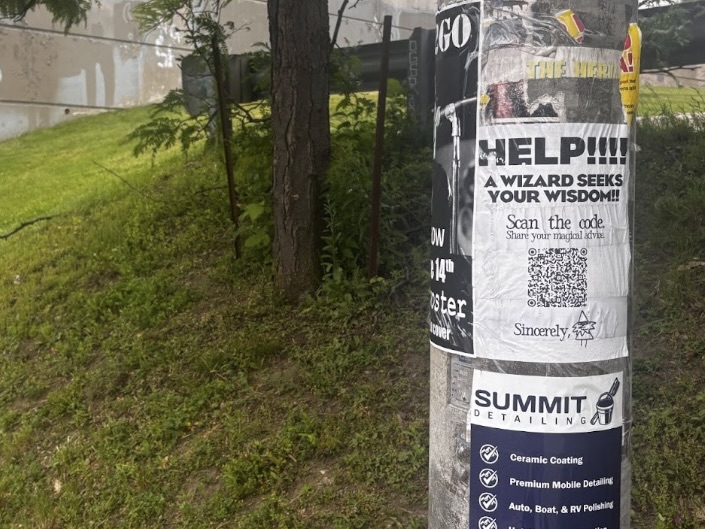
Stevens said he plans to compile the advice he has received through the QR code into a small-batch book published for Ottawa communities.
Although Stevens is aware of the possible repercussions of tagging public property, engaging with communities is his top priority.
“I’m putting a little bit of love and happiness into the world, and that’s my legal blanket.”
Stevens is not the only Ottawa artist integrating QR codes into their work.
Medea Rasheed has been examining the relationship between public art and communities since 2021. Now in her final year studying design for her master’s degree at Carleton, her thesis challenges what it means to engage with public art.
QR codes can help people learn by connecting people to art on their own personal devices, Rasheed said.
For her thesis, Rasheed displayed a sculpture and a QR code at different Carleton campus hotspots to assess how bystanders interact with art and digital tools.
Like the rest of Rasheed’s work, the sculpture is inspired by Arabic calligraphy.
Consisting of six different pieces, the metallic lettering connects into a symbiotic shape. Upon scanning the QR code, an augmented reality version of the sculpture is presented through a Snapchat filter.
The sculptures’ different pieces flare with colour and come apart, offering an entirely new interpretation of the piece.
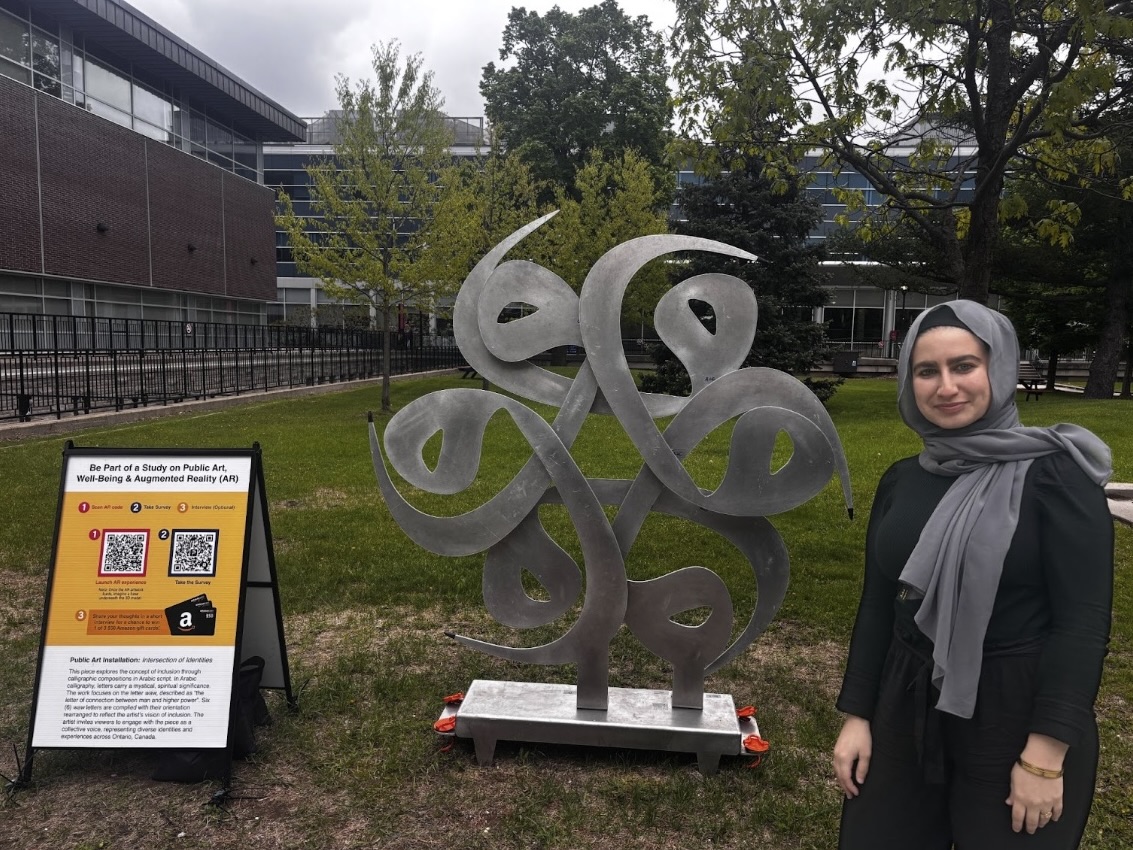
Using an additional QR code, viewers can participate in a brief survey to reflect on how the sculpture impacts their well-being.
The survey produced critical feedback revealing curiosity and preference for either the digital or physical sculpture. Rasheed said the strong responses arose from the QR code survey method.
“It’s embedding the art into your everyday routine when you use QR codes,” Rasheed said. “Would people actually read [the information] on a plaque as [thoughtfully]?”
Heather Anderson, the interim director of the Carleton University Art Gallery and adjunct professor of art history, is also interested in the evolving role of QR codes in art.
As the interim director, Anderson helped Rasheed with the logistics of her thesis.
“The QR code and the physical sculpture itself are both like a portal to this digital space which enables people to have an experience that the artist has created for them,” Anderson said.
The gallery has been considering the benefits and drawbacks of QR codes as the technology evolves, Anderson added.
“It can risk being lazy if you’re not providing certain information and then making people seek it on their phone,” she said.
“But if there’s something that can only exist in the digital space, it has a purpose beyond just what you would normally do in an exhibit anyway.”
CUAG has never showcased an exhibit that uses QR codes as part of the show, Anderson said, but that will change come September.
Scheduled from Sept. 14 to Dec. 14, the art gallery’s Unknown Area exhibition will use QR codes as a bridge between sound, touch and optical experiences. Co-creators Andy Slater and Emily Cook are on the blind spectrum and have designed the exhibit to challenge art as a strictly visual spectacle.
For the exhibit’s development, the artists embarked on a sound walk across Carleton’s campus, mapping areas like the tunnel system and Tory Building through ambient audio recordings. These snippets will appear in the final exhibition, accessible through QR codes.
Drawing inspiration from Rasheed’s thesis, new exhibits aren’t the only spaces where campus art may be redefined.
The gallery has also begun to contemplate how permanent on-campus art might also benefit from QR codes, Anderson said.
One sculpture at Carleton lacking description includes Wings by Gord Smith outside the St. Patrick’s Building.
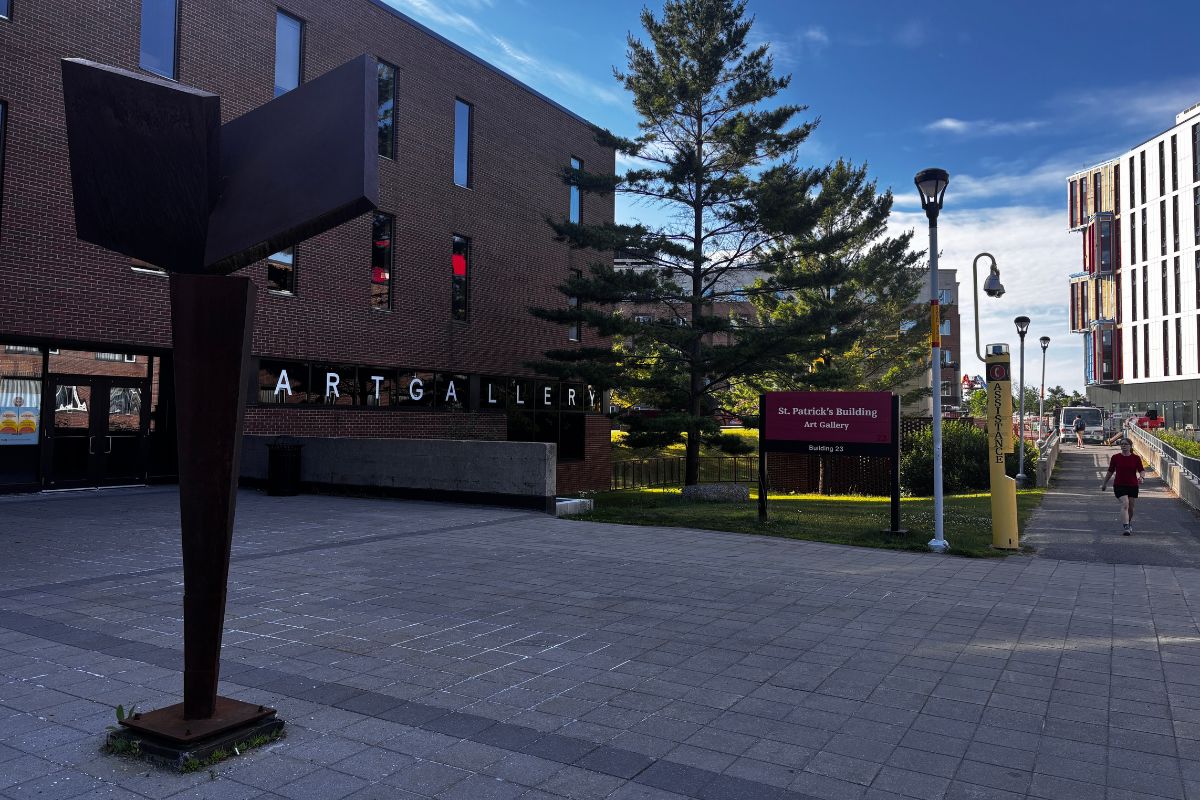
“We have been thinking of developing basic signage, but also QR codes that could be an entry point on campus for people to get to know these artworks,” Anderson said.
The project is still in the early stages, with the gallery team meeting during the summer months to visit the sculptures and establish a timeline.
But for Stevens, there’s more to public art than its audience becoming familiar with the work.
Supporting physical art will always be important, Stevens added, noting the medium keeps creators in control of their art.
“It’s a beautiful thing, sharing art like this, because a lot of artists are sort of stuck trying to get popular on Instagram or TikTok at the mercy of the algorithm,” Stevens said. “What’s nice about doing tagging is that it’s sort of guaranteed that people will see it.”
Editor’s note: This story has been updated.
Featured graphic provided by Patrick Stevens