
White noise is littered with chirps, chatters and electronic beats, weaving together to create an oceanic soundscape.
This is the “fictive radioscape” put on by Ottawa-based artist and author Paul Jasen at a Carleton University Art Gallery’s event, A Sonic Bridge.
“We opened with the quote, ‘Radio was heard before it was invented,’ so we get this idea that this is an eternal space,” Jasen said before presenting his audio recording, The Ether is Free.
“We just happened upon it about 160 years ago.”
Jasen played his audio recording, which he released with artist Nathan Medema, at the event presented by Debaser at the Carleton Dominion-Chalmers Centre on Nov. 7.
The synthetic buzzes and whistles explore the space that has always existed within radio before it was enclosed by human interference. Jasen described the movement of static sound in its purest form as an electromagnetic wilderness.
While exploring this wilderness in the last few years, Jasen released his own DIY radio transmitter kit — complete with a circuit board, assembly instructions and a digital download code, all fitting into a container resembling an Altoid tin.
His project looks to challenge the corporate operation of radio transmission that he said threatens individual creativity within the space.
“(Radio) is there to reoccupy, to explore, and I accept that maybe I err on the side of coming off naive with this, but why not, right?” Jasen told the audience during the event’s Q&A session.
“Those are the types of things that are good to hear about, not just because they make us happy, but because this is an actual thing that we can make use of.”
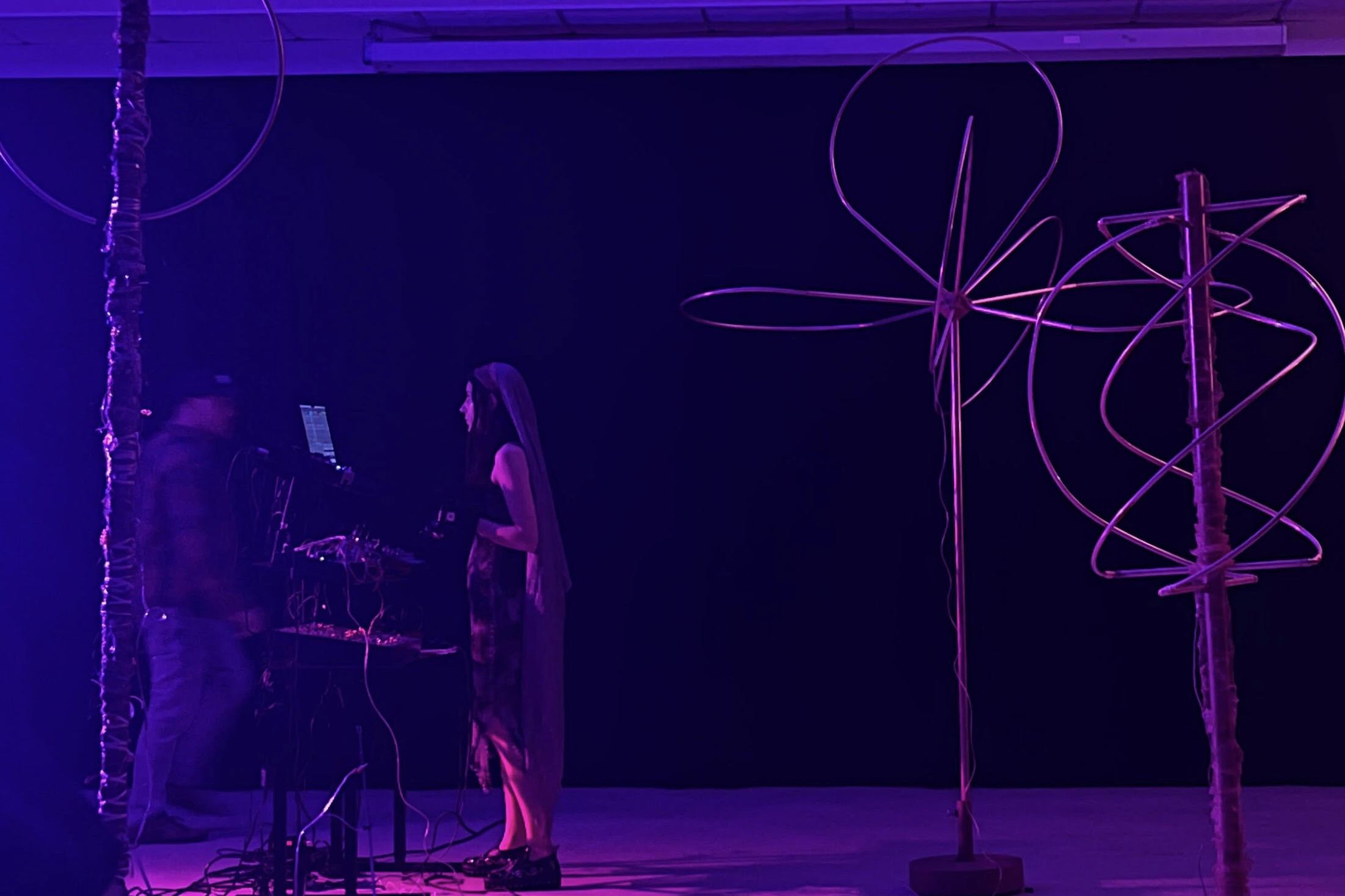
Following Jasen’s project, hues of purple-pink light flooded the room for sound artist Florence-Delphine Roux’s contemporary movement performance, Chronique d’Ether.
Roux placed a small radio and three bronze, twisting structures in front of her. Radio static crackled between voice recordings and synth tones. Roux bent toward the radio, with black gloves that act as receivers to “catch” the frequencies. She touched the antennae attached to the radio and pulled her arms back, seemingly pulling the sound with her.
As Roux moved between three structures, she appeared to harness the sound and frequencies of her antennae and electricity in the devices, as well as the electricity in her body and in the air, to create a sonic dance.
Rachel Weldon, a director at Debaser, spoke about the performance in the discussion with Roux.
“When I look at (the radio), I don’t think of it as a receiver — I just think of it as an instrument,” Weldon said.
“The antennas, from a visual standpoint, could be seen as resonators, as transmitters, or other receivers.”
Jasen and Roux’s art opposes the belief that radio and telecasts are obsolete or a “dying media.”
“In apocalypse movies, everyone’s running around because there’s no Internet. What are they doing? They’re listening to the radio,” Jasen said.
“It does have this ability to persist, and I think that is a real strength.”
Featured image by Mohini Rampersad/the Charlatan