

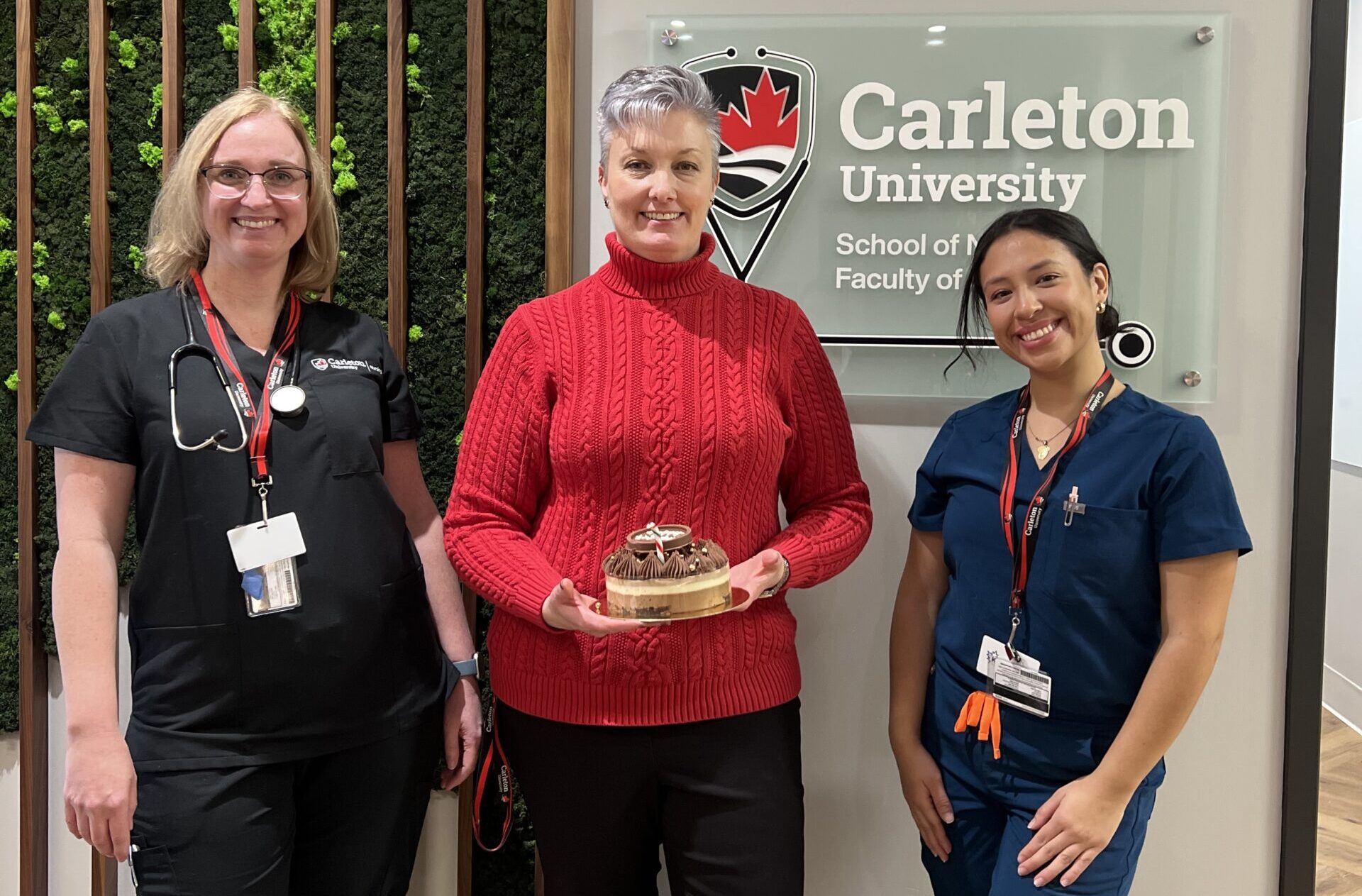
Launched in September in partnership with Ottawa’s Queensway Carleton Hospital, Carleton University’s new nursing program is looking to address a nursing shortage in the province.
The program brings many firsts — it’s the first nursing program at Carleton, and Ontario’s first new nursing program in more than 20 years. It’s also a compressed program that spans three years, compared to the typical four-year-long Bachelor of Science in Nursing programs in the province.
Carleton’s strategy is already paying off, according to Danielle Manley, director and associate professor in the new nursing program.
With the first semester completed and the second underway, Manley said the program underwent an “amazing” start.
Incorporating AI into nursing:
Manley said she noticed a “theory gap” during her time working as a nurse. She said nurses didn’t understand the workings of technology they used every day.
“Nurses are always invited to be consultants with computers, but it’s usually at the end of the design of the computer,” she said. “A problem will be identified, it will be given to IT. IT will define a solution, and right before they implement it, they’ll say, ‘Hey, can you come see if this works?’”
“And the frustrating part for nurses is that often it doesn’t work, and it wasn’t designed with nurses.”
Now, she’s shaping the next generation of nurses by helping them learn those skills. Nursing Professional Practice (NURS1001) is a mandatory first-year course for the first cohort of students majoring in the Nursing program at Carleton.
Manley said she starts with the basics.
For one of their first assignments, students in NURS1001 used ChatGPT to create a tailored schedule of their classes and commitments, but had to ask their professors for permission to upload their syllabi to ChatGPT.
“They had to reflect on (the idea of) do you own your own data?” said Manley, adding that the exercise led to a conversation about intellectual property. “AI is an umbrella term, and it can mean anything from spell check to the beep in your car.”
In a healthcare setting, the patient is the owner of their data, and the institution is the custodian, Manley said.
“(Healthcare professionals) can’t just take patients’ data and start throwing it into ChatGPT, because that’s not ethical. We had to set that foundational stage.”
To further explore the intersection of AI and healthcare, students can opt for a concentration in Nursing Data Science.
“AI is expanding so rapidly that it’s inappropriate to teach a single AI tool — because it’ll be obsolete by tomorrow,” Manley added.
Addressing the nursing shortage:
The Ontario Learn and Stay Grant is part of the province and Carleton’s solution to address the healthcare shortage.
This provincial grant covers Ontario high school students’ tuition, books and other educational expenses in exchange for working for a period in the region where they studied after graduation; in this case, Ottawa.
“For people who come from lower incomes, (the grant) makes it much more accessible,” said Lea Mirea, a first-year nursing student and president of the student nursing society.
“For people like me, I can actually save money and not be in debt.”
Students can also choose a concentration in mental health and neuroscience, an option that Manley said will alleviate some of the strain on the healthcare system by creating more providers who specialize in mental health.
“We see our emergency departments overwhelmed,” Manley said, adding that many people coming into the emergency room require mental health care.
Because registered nurses can work as psychotherapists and graduates of the program will be able to prescribe medication, Manley said the idea is for graduates of the stream to open their own psychotherapy practice.
“The nurse could do your intake assessment in a calm environment, not in an (emergency) environment, (and) without a 16-hour wait,” Manley said.
Classes and structure:
On the other hand, the compressed three-year program prevents students from enjoying four-month summer breaks like typical academic cycles.
Instead, nursing students only receive a month and a half of downtime in their first year. Their next two summer terms are clinical placements, where students work full-time.
“In the first summer, I’m very aware that our students are going to see their friends on campus leaving. It’s going to feel heavy because they won’t have the break that their friends have,” Manley said.
To combat this, she included a for-credit class called Resilience Training (NURS 2012) that teaches students about mindfulness, reflection and meditation.
“We put it in the summer exactly for that reason,” Manley said.
Student experience:
Students who have enrolled in the new nursing program say that in spite of some hiccups, they’re enjoying their academic journey. Many instructors hired were nurses with little to no teaching experience, one student said.
Ray Wei, a first-year nursing student at Carleton, said new instructors tend to teach heavy content, adding students would have to spend days filling the gaps on their own.
Wei said she still thoroughly enjoys the program.
“They listened to our advice, and I heard that they might make some changes in the future in regards to the course arrangement.”
Mirea said that students and the nursing society are always giving feedback.
“We all understand that it’s a new program, so some things are still a little bit unorganized, but that’s the fun of it, honestly,” Mirea said. “We get to influence how it is organized in the future.”
‘High stress, low stakes’ approach to simulations:
The Experiential Learning Simulations are a type of lab class where students roleplay as nurses in a hospital — complete with human-scale mannequins.
The mannequins can speak, breathe and bleed, Manley said. Students can also take their blood pressure, drain urine and insert needles.
The environment created in simulations is “high stress, low stakes,” Manley explained.
The noise and chaos of beeping machines and rushing people accurately simulates a health-care environment.
“If I give this simulated mannequin the wrong drugs, they won’t die — they’re a mannequin,” Manley said. “But we still take it as a critical event, and we talk about what would have happened so that people have the opportunity to make these mistakes.”
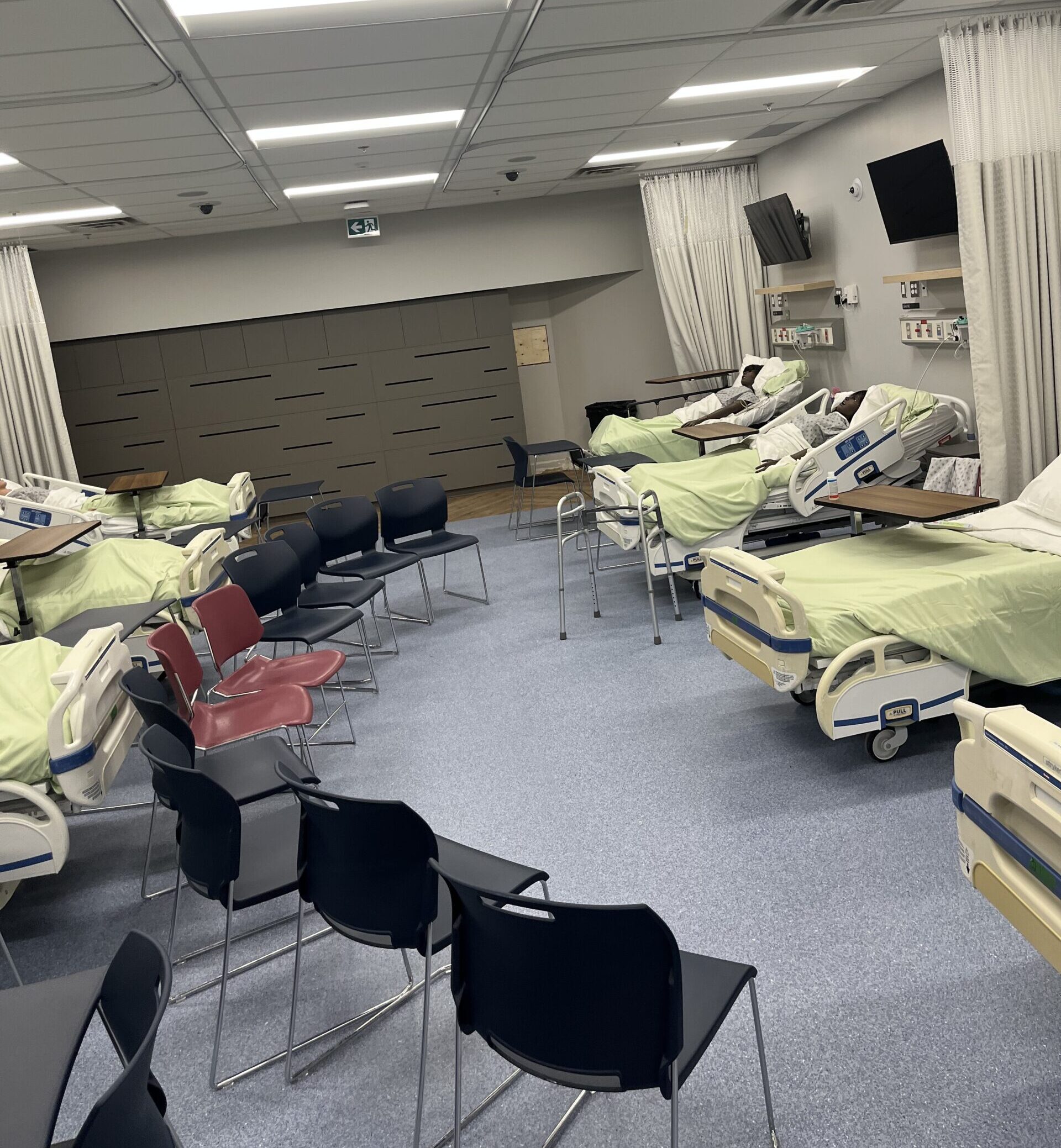
First-year nursing student Alexis O’Connor said simulations are also confidential to mimic a real hospital environment.
“In hospital care and in patient care, you can’t disclose information,” O’Connor said. “Obviously we’re not perfect, we’re human, and we’re going to make mistakes, but we want to ensure that our patients are safe and that their information is safe.”
O’Connor said students are not allowed to wear scents in the simulations and are expected to wash their hands every time they enter or leave.
The simulations take place twice a week at the program’s satellite campus in Kanata.
Program culture:
The program has 110 students, Mirea said, which she enjoys because she knows everyone by name.
As president of the Carleton Student Nursing Society, Mirea hosts a social event for the program once or twice a month.
“I think it’s really important to have a close community in this kind of program,” Mirea said. “A lot of nurses talk about their friends they’ve been trauma-bonded with, so it’s nice to have that kind of support so early on.”
O’Connor said most of their professors are women, which creates a more empathetic environment.
“They’re powerhouses,” O’Connor said. “I feel more connected to them — they’re on the same journey.”
First-year student Aidan Louie said Manley would bring treats to her lectures, which “helped to build a strong community.”
Despite being only one of seven male students in the program, Louie, who represents them as the nursing society’s male advocate, said being in a woman-dominated environment doesn’t bother him.
“I was nervous about it, and the other guys were, too,” Louie said. “But honestly, the other guys in my program very quickly became friends and kind of became a friend group.”
“There’s a saying that ‘nurses eat their young’ and they try to make it really hard,” Louie added. “But all the professors and teams here at Carleton have been very supportive and stated many times they want us to succeed.”
Featured image provided by Katie McCarlie/School of Nursing
This article, and all of the Charlatan’s work, is brought to you by an independent student newspaper dedicated to informing, uplifting and entertaining the Carleton University community. We are a levy-funded organization which plays a role in the broader, vibrant student culture on campus. By reading this article, you are supporting our efforts.