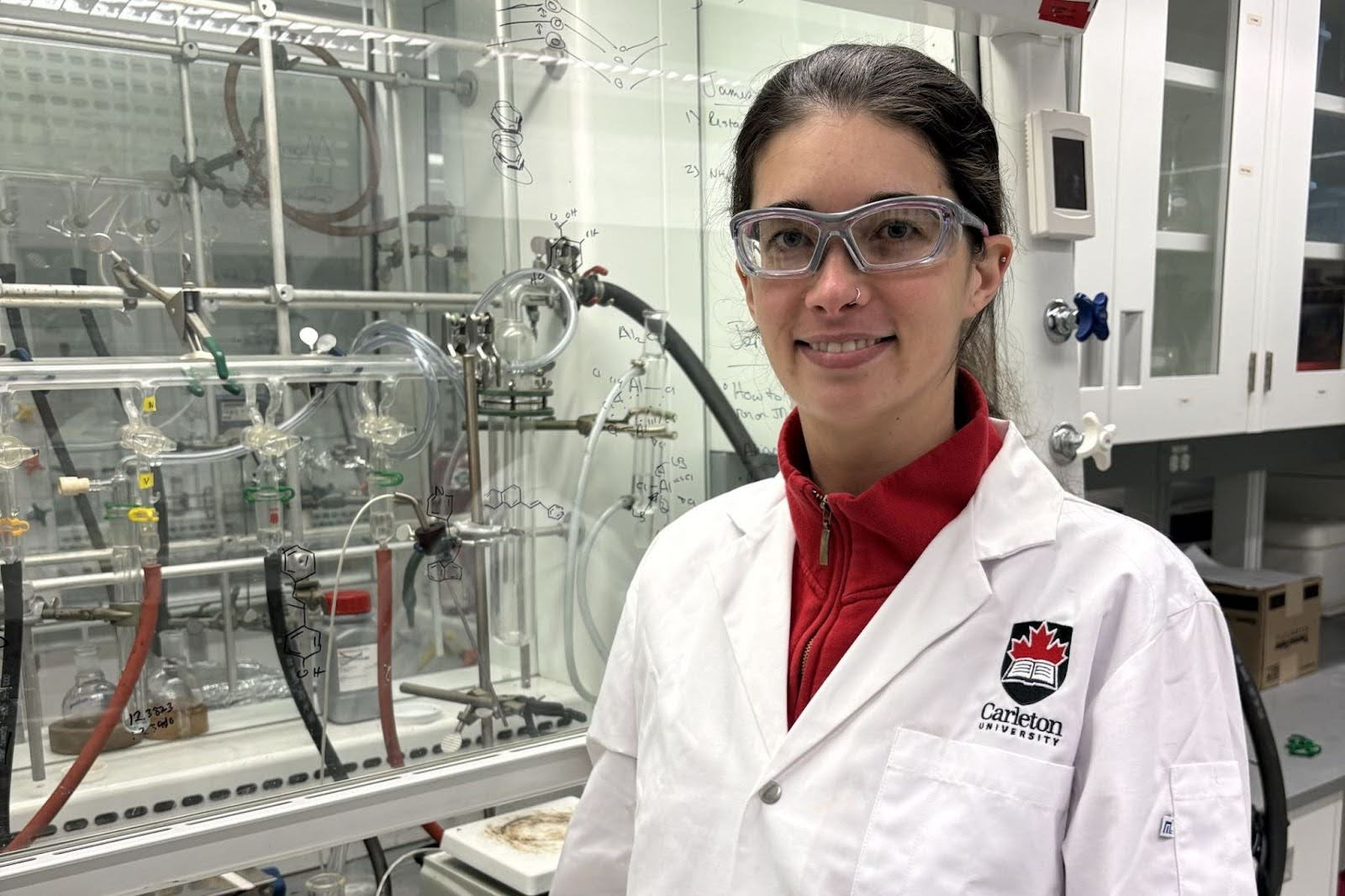
Kate Marczenko is shining light on a new way to produce explosions — literally.
Marczenko is a Carleton chemistry professor and winner of the 2025 John Charles Polanyi Prize, an award recognizing early-career researchers across Ontario. She is the first recipient from Carleton since 2017.
Marczenko’s research mixes energetic materials, commonly known as explosives, with photoresponsive materials, which are substances that react to light.
She does this by looking closely at the way particles in an object are organized at a molecular level and how changing specific elements could influence its characteristics — a niche of chemistry called crystalline systems.
The Charlatan spoke with Marczenko to find out how she’s lighting up chemistry research after her win.
The Charlatan (TC): How would you describe your work to someone with less expertise on this subject?
Kate Marczenko (KM): What we’re looking at are crystalline materials. So if we think about solid materials, solids we know are distinct from liquids and gasses. They are their own unique phase. But that solid can be broken down, and we can further understand the specific arrangement of the atoms, which are particles that comprise that solid.
If we’re thinking about the bricks that are used to build a house, we could stack the bricks directly on top of each other, but what’s often used is an inter-layer interlocking technique.
The walls of a house are composed of brick, but the specific arrangement of those bricks matter and impart different properties, more specifically, stability.
We can view atoms of a molecule which have crystallized in a very similar way.
TC: What is your research focusing on?
KM: We are able to create materials that undergo a specific chemical reaction when you shine light on them.
We’re also really interested in energetic materials, which is just a fancy word for explosives. We’re looking at how we can bridge this area of explosives with this area of photoresponsive materials.
One strategy we’re looking at for doing that is co-crystallization. We look at the crystal structure and modifications that can be made at that level to try and combine both of these worlds. We’re doing that by taking a photo responsive molecule and an energetic molecule and asking, “Okay, what if we force them to be in the same crystal structure, and be in the same actual material?”
If you think back to that brick wall analogy, you’re effectively adding in a different type of brick. That changes the overall crystal structure and therefore material properties.
TC: Why merge these two concepts?
KM: Energetic materials have the energy properties or functions required for explosions, but they are often very unstable. Some of the stuff we’ve worked with have been shock sensitive, so they’ll detonate with the touch of a feather. We’re trying to stabilize those molecules, but also reinvent the trigger.
Energetic materials are typically initiated with heat or impact shock, but what we want to do is actually initiate them with a very specific wavelength of light.
I can envision our specific ultraviolet dose being like an “on switch.” There’s a need for safer material that is safer to transport, safer to set up, safer to work with, and it isn’t until you apply the “on switch” that it then enters its explosively active form.
The biggest benefit that I see with this system is that, in theory, the energetic form transported is going to be different from the energetic form of the explosive.
TC: How could this be used in real life?
KM: The idea of developing explosives is not necessarily for weapons. It’s not to do harm to others. Think about the idea of propellants, launching satellites and rockets into space but also in mining.
Being able to use a non contact stimulus, such as light, means that we don’t have to use extended fuses for ignition. We could now think about remote initiation because light is a non contact, highly controllable and precise stimulus.
TC: How has winning the 2025 John Charles Polanyi Prize shaped your work and life?
KM: It provides visibility to early-career researchers, which is really important. You’re trying to establish a new identity that’s different from the work you’ve done in the past under different advisors, because you want to show that you can stand on your own two feet.
It provides a sense of recognition that I am here, I am successful, we are doing cool and interesting work, which can open up doors for collaboration and different funding opportunities.
On a more personal note, I started at Carleton in July 2023 and went on maternity leave a year later, so it’s extra validating to get this award because I did take personal leave for a year.
You always wonder the impact that will have on your career. You never want to have to choose between having a baby, starting a family and your career.
Winning this award feels like I didn’t have to choose. It feels like I was able to have both, which is really nice.
This interview has been edited for length and clarity.
Featured image provided by Kate Marczenko
This article, and all of the Charlatan’s work, is brought to you by an independent student newspaper dedicated to informing, uplifting and entertaining the Carleton University community. We are a levy-funded organization which plays a role in the broader, vibrant student culture on campus. By reading this article, you are supporting our efforts.