

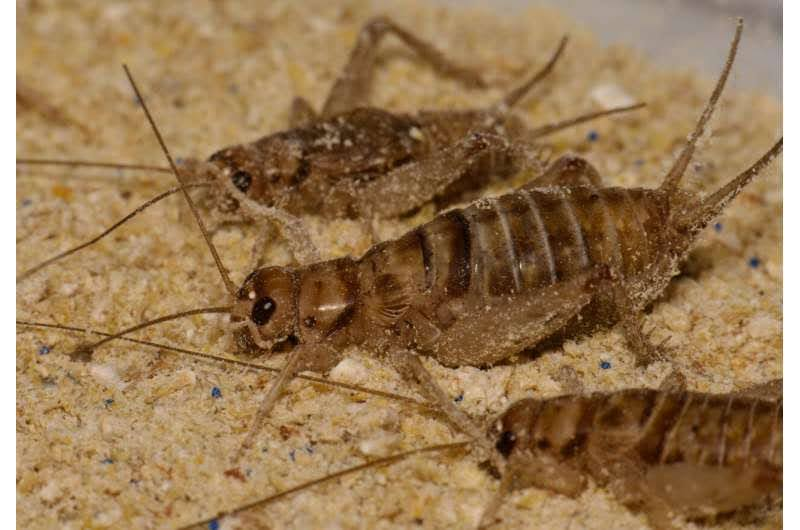
Crickets in a Carleton lab are dining on microplastics, and according to researchers, they are growing hungry for more.
Carleton biology associate professor Heath MacMillan and PhD student Marshall Ritchie’s newly published study looked at what sizes of microplastics crickets might eat and what amount of plastic is excreted.
During behavioural experiments, they found that crickets did not avoid eating microplastics when given the choice.
The Charlatan spoke with MacMillan to learn more and digest what this means for the environment.
The Charlatan (TC): What was the goal of this study?
Heath MacMillan (HM): We had quite a bit of knowledge already going into this study, as Marshall had done some work as a master’s student looking at how the plastic is degraded as it goes through the digestive system.
We found crickets chew up plastics quite a lot as they eat them. They’ll eat microplastics — which is anything from one micron to five millimeters in size — and poop out much smaller microplastics, but also nanoplastics. So even smaller than one micron.
Nanoplastics are really scary because they have the potential to cross between cells and access other parts of animals’ bodies, rather than staying inside the gut.
For this study, Marshall was trying to ask questions of what determines whether an insect will eat a plastic and turn it into nanoplastics. We were really interested in size.
TC: What were the steps to complete the study?
HM: We’re manipulating the crickets’ diet. We’re changing which plastics are there and how much of these plastics are there, and following them throughout their life.
Then there were different steps of looking at their digestive system. What’s inside their gut as well as what’s coming out the other end in their poop. For both the gut and poop samples, we have to be able to isolate the plastics from them.
TC: What was the result?
HM: So far in the crickets, we’ve been struggling to find bad outcomes from them eating the plastic. They seem remarkably tolerant of it, actually.
We’ve done up to 10 per cent of their diet as plastic, which is a totally unrealistic amount. It’s not what they would encounter in nature, but they still grow and survive just as well.
It could be that plastics are not impacting them, but it also could be that we’re not asking the right questions.
TC: What does this mean for real-life situations?
HM: In nature, crickets are eating plastics if they’re available to them out there. This stuff in the lab is telling us that if they eat plastics, they have this ability to break them down.
That can mean a couple of things. Insects are a really important food source for lots of other animals, like birds. If they’re eating crickets after they’ve eaten plastics, they’re then ingesting those plastics. Then, we might have problems with the birds.
Now, if nothing eats them, and the cricket is still walking around, it’s going to be pooping out those tiny plastics. Now, lots of other animals, like soil-dwelling invertebrates, might come along and now encounter microplastics or nanoplastics that they otherwise wouldn’t have encountered.
TC: Why do insects and microplastics matter?
HM: Insects play a huge number of important and unappreciated roles for us. Much of what we do depends on them.
Roughly 75 per cent of the crops that we produce rely on insects for pollination. They’re an important food source for other animals.
If we are continually dumping waste plastic into our environment, and we don’t understand what the impacts of that are on this really important group of animals, then I think that’s a big issue.
This interview has been edited for length and clarity.
Featured image provided by Matthew Muzzatti.
This article, and all of the Charlatan’s work, is brought to you by an independent student newspaper dedicated to informing, uplifting and entertaining the Carleton University community. We are a levy-funded organization which plays a role in the broader, vibrant student culture on campus. By reading this article, you are supporting our efforts.