

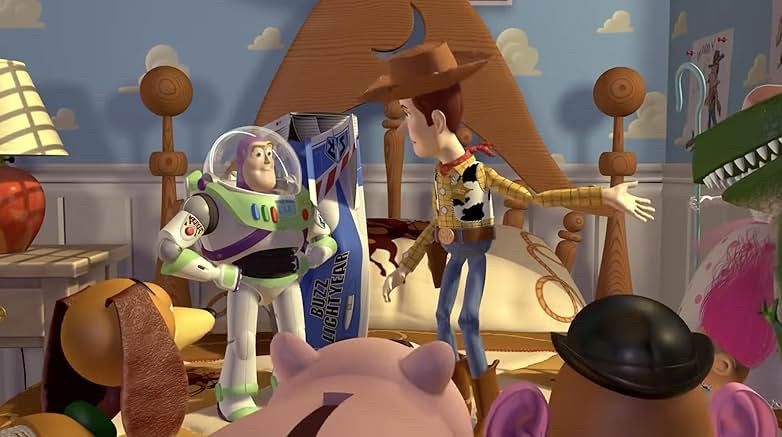
When I think of the Toy Story movies, I’m flooded with nostalgia.
As I get wrapped up in the animated world of toy cowboys, space rangers and slinky dogs, I’m also reminded of my first time watching the series.
I was three or four years old on my first trip to the movie theatre. There was a special double feature of Toy Story 1 and 2, and my older brother had been hyping up the experience for me all week.
My family brought me to the theatre wearing my Toy Story sweater and sneaking M&Ms in my pockets to make up for my distaste of other movie theatre foods. I remember my parents reminding me to stay quiet once the movie started, checking in on me throughout.
But what I didn’t fully grasp in my first watch is that Toy Story is all about change. And as I grew up from the little kid who needed a booster seat in that theatre, the way I viewed the movie changed too.
Like many people, I’ve always been a person who’s struggled to accept change. While it’s never stopped me from moving on — and in some ways, I’m often excited for a new chapter — I hate to leave memories behind.
From feeling unnerved when turning a new age on birthdays (even as a five-year old) to agonizing over donating old toys (okay, that might be Toy Story’s fault), to bawling my eyes out every time I get on a plane, change has always been uncomfortable for me.
Each of the four Toy Story movies captures this pain — while also emphasizing why it’s so important to embrace it.
In the first movie, Woody desperately tries to fight change when his position as Andy’s favourite toy is overtaken by the flashy new space ranger, Buzz. He tries to sabotage Buzz’s chance to accompany Andy to Pizza Planet, in the hopes Andy will take him instead.
Although he almost gets his wish, he eventually loses his friends’ trust and ends up at neighbour Sid’s house — a well-known toy abyss.
Woody is forced to accept he needs to leave behind his past as Andy’s favourite toy and instead focus on a new chapter where he can lead with Buzz by his side.
Once Woody finally embraces this partnership, he’s no longer miserable. Instead, he and the other toys work seamlessly in a new way that wouldn’t have been possible before.
I often think of this lesson from Woody and Buzz to remember that change can be positive.
The second movie confronts a different kind of resistance to change through a more secondary character, Jessie.
Jessie was once hurt by a change she couldn’t control — her original owner, Emily, moving on from her. This makes Jessie afraid of further change and makes her yearn for a stable unfulfilling life as a toy in a museum.
Woody eventually helps her realize when it comes to seeking true happiness, taking risks is important, even when you know the new reality may not last forever.
Jessie’s story has translated to various points of my life where I’ve been faced with the choice of staying comfortable, or pursuing more rewarding yet daunting paths.
Toy Story 3 and Toy Story 4 take the first movie’s message one step further.
In the third movie, Woody and the other toys realize Andy doesn’t need them anymore, and it’s time for a fresh start with a new owner, Bonnie. In the fourth, Woody realizes his new beginning doesn’t even involve Bonnie or most of the other toys. Instead, it involves being a “lost toy,” where he embraces a new lifestyle with his partner, Bo Peep, without an owner.
These two movies show that while sometimes it’s possible to keep the old and the new when growing up, there are other times where the past needs to be left completely in the past. Although Toy Story 3 and Toy Story 4 are by far the most heartbreaking, they’ve stuck with me the most.
I like to think the stories we consume growing up help prepare us for tough decisions in life.
And when it comes to facing decisions about growing versus staying comfortable, Toy Story has taught me to accept the nostalgia, but to embrace the change.
This article, and all of the Charlatan’s work, is brought to you by an independent student newspaper dedicated to informing, uplifting and entertaining the Carleton University community. We are a levy-funded organization which plays a role in the broader, vibrant student culture on campus. By reading this article, you are supporting our efforts.