
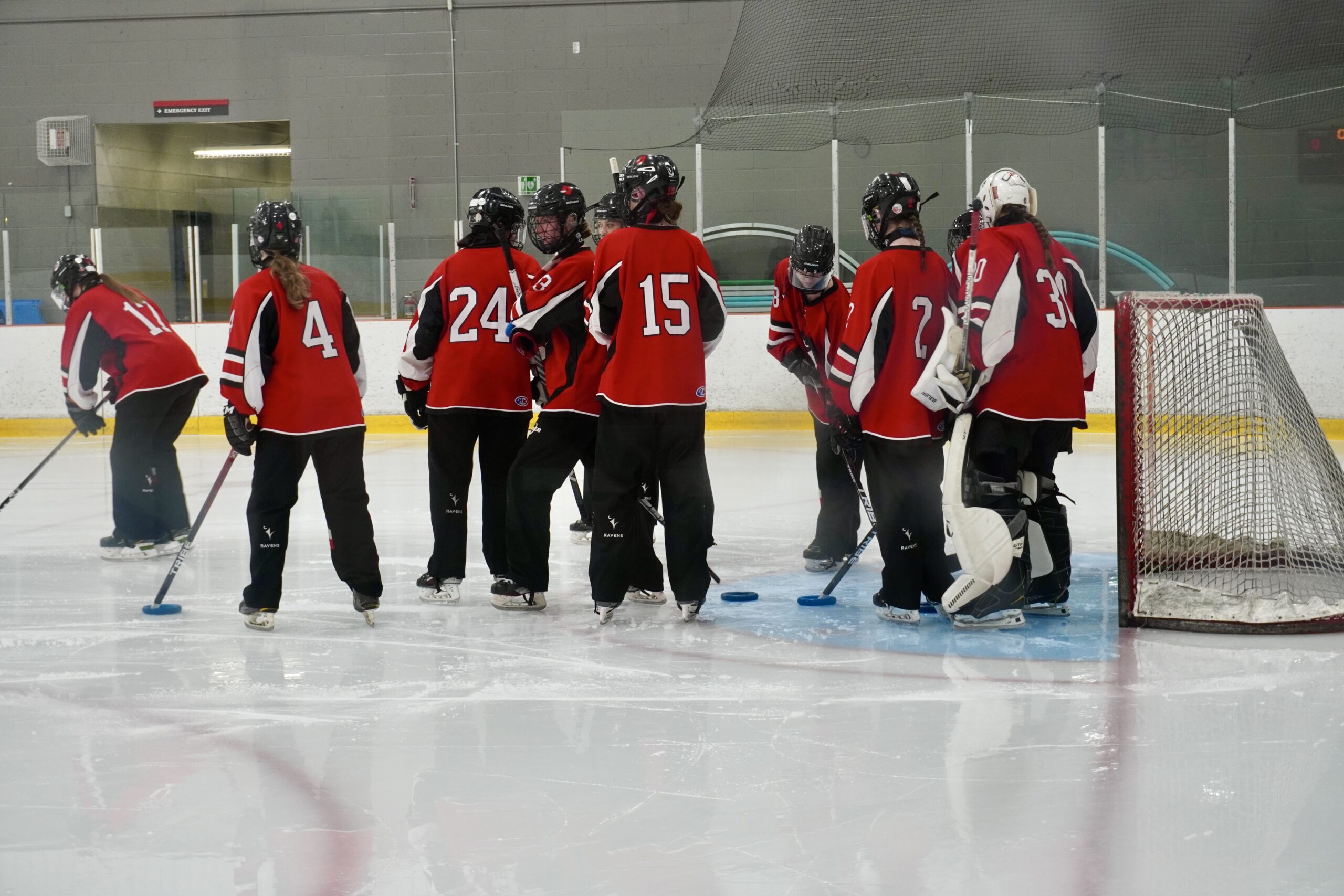
As Carleton University’s ringette season winds down, the sport is still ramping up in Ottawa, with the city set to host the Canadian Ringette Championships in March.
Drawing teams from across the country, the championships bring together hundreds of athletes, coaches and volunteers, proof of the scale and community of the sport.
Carleton co-captains Isabel Dancause and Olivia Weylie know that shared love of the sport well.
Both players, who grew up in Ottawa’s ringette scene, shared their thoughts on how the sport has offered them a sense of belonging.
The Charlatan (TC): What is your ringette background?
Dancause: I’ve been playing ringette with the City of Ottawa Ringette Association
since I was four years old, and doing this at the competitive level for at least 13 years. Currently, I’m playing defence for Carleton’s team.
Weylie: I’ve been playing ringette for 13 years.
Now, I’m a centre for the Carleton Ravens and am affiliated with the Eastern Ontario Capitals National Ringette League team.
Over the course of my ringette career, I’ve participated in two Ontario Winter Games and two Canadian Ringette Championships. My passion for ringette has also fueled my desire to give back to the community, and I’ve been a ringette coach for the past six years.
TC: What do you enjoy most about ringette?
Dancause: The community it has given me.
The bonds I’ve made thanks to ringette are some of the closest friends I’ve ever had or will ever have.
I’ve been lucky enough to have many successful seasons over the course of my career, but I think some of my favourite moments have come from the bond and trust that losing as a team can give you. In my first year on the Carleton ringette team, we were in a tournament in Oshawa.
It is the single most fun I have ever had in a game, despite losing something like 14-7.
Weylie: The camaraderie between teammates. The nature and rules of the game of
ringette encourages this bond; it is impossible to get the ring down the ice without your teammates. This bond translates off the ice as well. Outside of the sport,
ringette has taught me the vital skills of teamwork and leadership.
TC: Why do you think ringette matters?
Dancause: I think ringette matters because it can be such an important space for girls to grow and form connections they might not otherwise. It can be incredibly difficult to just exist as a girl, so finding that community to surround yourself with can be so crucial for mental and physical health.
Ringette has given me a stable outlet for my mental health, and I think it has the capacity to do that for so many girls and women. It has also taught me about how to support others and how to be a good leader.
Weylie: I took a course titled Keeping Girls in Sport, and what really stood out to me was how the steps for keeping girls in sport are different than with boys. For boys, they gain a sense of belonging by succeeding in their sport.
On the other hand, girls need to feel a sense of belonging first before they put effort into the sport. Ringette matters because it is a community for young girls in sport.
TC: How would you describe the culture or community around ringette?
Dancause: So much time spent dancing in the dressing room, or even bringing our
speaker out into the arena and dancing together right before a game, screaming lyrics and laughing so hard we’re nearly crying. I’ve never been on a team that has kept up cheering so loudly despite still losing, or one that has supported each other as well as this one does. I love these girls with my whole heart, and would do anything for them.
Weylie: As a lesser-known sport, the ringette community is very tight-knit, we rely on each other and are united by our love for the game. As a result, everyone seems to know everyone. Furthermore, unlike the rarity of a hockey player meeting and
interacting with an NHLer, it is quite common for young ringette players to meet and
learn from their NRL idols.
This allows players to see a representation of what they can achieve and that their dreams are not far from reach.
What really stands out to me within the sport is the impact of female role models on
young players. The specific moment that stands out to me is when a parent
told me the athlete I coached was talking about how cool I was and that she wanted
to be just “like Coach Olivia.”
TC: Is there anything else you’d like people to know about ringette or
your experience with it?
Dancause: It’ll never be a perfect experience or space, but ringette has helped me through some of the toughest parts of my life, and I know it has done the same for
many people. I hope the university division continues to flourish so that girls can
continue to play their sport while extending their academic careers, because I couldn’t imagine my university career without this community.
Weylie: Growing up, I have heard ringette described as “hockey for girls” or “a
dumbed-down version of hockey,” and this is simply not the case. While at first
glance hockey and ringette may look similar, they are vastly different. In reality,
ringette is a game that is entirely unique, driven by speed, technique and precision.
Interviews have been edited for length and clarity
Featured image by Chloe Rahman/the Charlatan
This article, and all of the Charlatan’s work, is brought to you by an independent student newspaper dedicated to informing, uplifting and entertaining the Carleton University community. We are a levy-funded organization which plays a role in the broader, vibrant student culture on campus. By reading this article, you are supporting our efforts.