
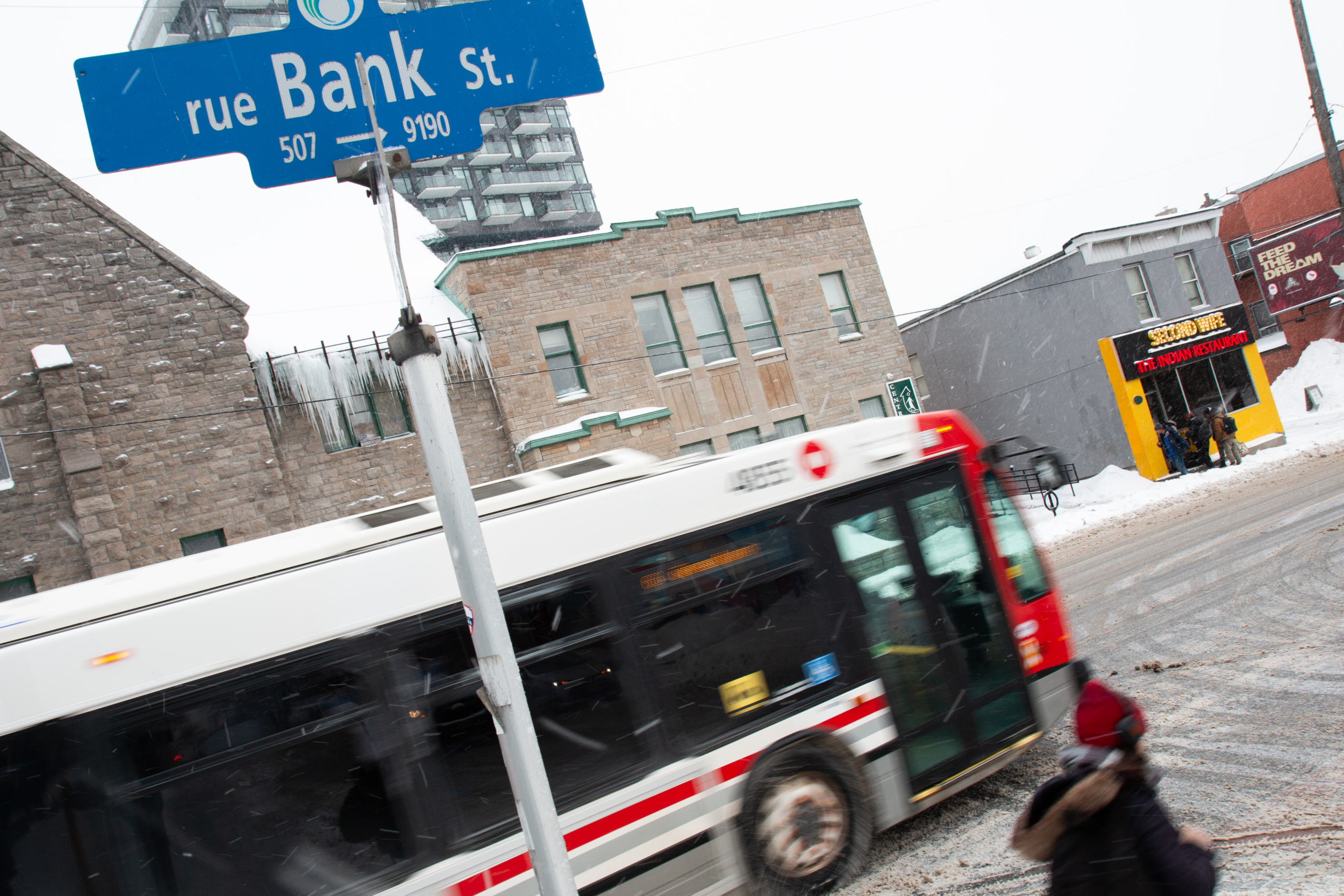
Students brought Bank Street into the spotlight during the BPAPM Case Competition that drew city councillors to campus last month.
Participants created proposals on how to make Bank Street better, with ideas like 24-hour bus lanes, bike route extensions, dynamic street parking prices or getting rid of street parking altogether.
Sixteen teams competed this year, more than five times as many as the previous and inaugural year.
The three finalists will get to present their proposals at city hall during the next public works and infrastructure committee meeting.
The top three teams proposed alternative street parking ideas to clear the curbside lanes for bus-only access. They all cited a City of Ottawa survey, where 60 per cent of respondents said they would be willing to park and walk five or more minutes to reach a destination on Bank Street.
The winning team was made up of five public affairs and policy management students.
Willow Côté, Sam Humphries, Ellize Manzo, Grace-Divine Kalombo and Mateo Mendez-Yepes offered an “incremental” solution.
Their proposal was to raise prices on street parking and create signage to show cheaper, alternative lots that already exist like the Lansdowne or Glebe parking areas. Then, the team suggested creating bus-only express lanes and a future tram system.
The team’s end goal was a “transit-forward future,” but they needed stepping stones to get there, Manzo said.
“We want to pedestrianize the street — we want a lot of public transit. How do we do that? We get rid of the cars. How do we get rid of the cars? We save people money, and we move their cars to existing lots,” she added.
Coun. Shawn Menard of Capital Ward, which encompasses Carleton University, was one of the judges. He said the winning team’s “implementability” approach understood neighbourhood and city dynamics.
“This is a big change. Everyone feels ownership over the streets that they walk on, or have businesses on or frequent,” Menard said.
“You have to try to improve things for everybody if you can, that is incredibly difficult to do.”
Daniela Valenzuela Neto*, the founder and chair of the competition, said the competition looks to give diverse voices a place in policy conversations and create a place for undergraduate students to tackle real-life problems, especially at the municipal level.
Many issues examined in political science and policy courses ignore what’s happening at the city level in favour of federal issues, she said.
City issues are “right under our noses (but) we don’t actually have the space to talk about it,” Valenzuela Neto said.
“It’s a very meaningful opportunity, especially for decision makers who are ultimately a lot older than us, for them to actually hear what we have to say.”
Among the decision makers was Coun. Tim Tierney, chair of the public works and infrastructure committee.
Tierney said the committee will “probably see some of these ideas come up.”
“I didn’t see anything that was really restricted and said, ‘We’re just doing this one way. That’s it. We want this,’” Tierney said.
“It’s all grounded in reality, which is exactly what I think our public works committee is really going to look forward to.”
The public works and infrastructure committee’s next meeting is set for Feb. 26.
*Daniela Valenzuela Neto has previously contributed to the Charlatan.
Featured image by Simon McKeown/the Charlatan.
This article, and all of the Charlatan’s work, is brought to you by an independent student newspaper dedicated to informing, uplifting and entertaining the Carleton University community. We are a levy-funded organization which plays a role in the broader, vibrant student culture on campus. By reading this article, you are supporting our efforts.