

Stasha Lysyk remembers walking through Carleton University’s campus when she came across two dead robins, victims of an invisible hazard: glass windows.
For birds, fully transparent glass seems like a continuation of their flight path, but windows can have deadly avian consequences.
Bird-window collisions are common, said Rachel Buxton, a Carleton biology assistant professor. Buxton is also the founder of the Carleton Conservation Collective, a group of faculty and students aiming to implement conservation actions on campus.
“It’s easy to relate to [humans] walking through a glass door,” Buxton said. “You’re outside in the summer and then you go to grab something inside, and you forget that the sliding glass door was closed, and you knock your head into the sliding glass door.”
For Lysyk, art presented a possible solution.
“If you put something on the outside of a window’s surface that breaks up that reflection, it tells [birds] that there’s something they can avoid,” Lysyk said.
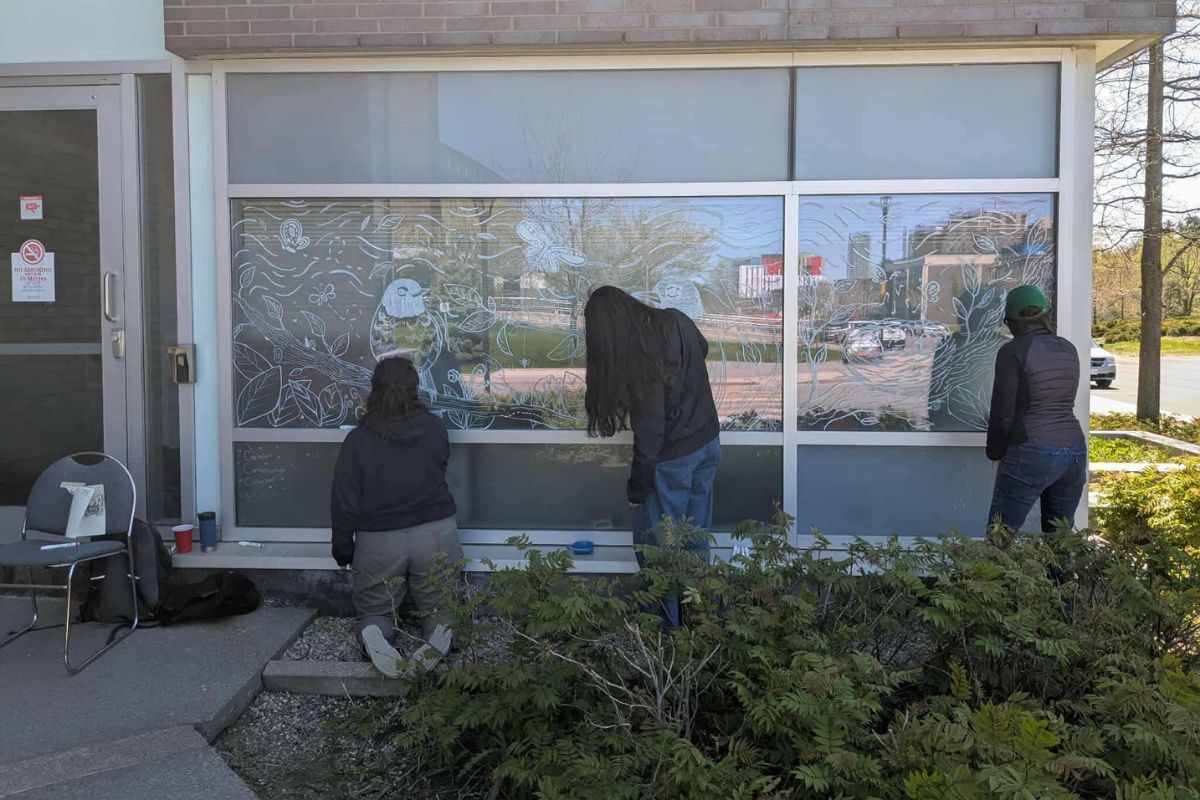
Combining her personal urgency after seeing the collisions’ impacts at Carleton with her master’s research on bird-window collisions and treatment methods, Lysyk led the Carleton Conservation Collective. Together, they created a nature-inspired mural that aims to prevent bird-window collisions.
“What was really fun about it was the people that were all there,” Lysyk said. “They contributed their own designs as we did it, and so it felt like an amalgamation of everyone that contributed that day.”
To honour the fallen robins, Lysyk’s Nesbitt Building mural captures themes of spring and renewal, showing the birds in flight among budding trees. Depictions of wind, butterflies and other natural elements are intertwined with the birds and trees, creating a visual representation of Carleton’s wildlife.
Brendon Samuels, whose PhD research at Western University focused on bird-window collisions, said the issue is significant across Ontario — and that most collisions occur at low-rise buildings and residences.
To Samuels, small groups taking action to prevent collisions is a step in the right direction.
“Students on a university campus can inform the kinds of actions that we want to see in broader society,” Samuels said. “By allowing the community to be involved in the design of artwork that is available for all to enjoy … I think we’re making campus more livable, and we’re empowering people to take action.”
The Nesbitt Building’s mural isn’t the first bird-window prevention display to pop up at Carleton.
Back in March 2024, students and the conservation collective partnered to create a mural through the walkway connecting the Mackenzie and Architecture buildings on campus.
Properly treating a piece of glass to reduce transparency and reflection shows birds that they cannot fly directly through the window, Samuels added, which prevents the collision from happening in the first place.
“Looking at where they applied it [at Nesbitt], that’s right at the corner that birds might try and fly around if they were taking a shortcut to get from one side of the building to the other,” Samuels said. “They designed the location of this based on evidence, which is exactly what we are trying to get the public to adopt and do all over the landscape.
“I think it really enhances the esthetic of the space.”
Ensuring the murals are esthetically-pleasing while preventing collisions was also important for Lysyk.
“One of the main things I hear when people say they don’t want to treat their windows is that they don’t look nice,” Lysyk said. “To have some really nice examples that are close to home … is pretty meaningful.”
As a student-led initiative, the mural was designed to be a manageable project, completed by a small group of volunteers from the conservation collective, Lysyk said. The group worked on the mural over the course of a May afternoon, using leftover materials from previous projects to reduce waste.
Creating the mural brought the biology department together to create meaningful change, Buxton said.
“In our lab and in the department of biology, a lot of us study conservation science and how to conserve wildlife. But we don’t actually do a lot of the conservation actions ourselves,” she said. “The collective and our tackling of window collisions feels like something we could do ourselves on campus.”
MacOdrum Library — specifically, the wall facing the Tory Quad — could benefit from a future mural, Buxton and Lysyk said.
The space poses a significant risk to birds due to its large glass windows, Buxton said, adding that a painted mural would also brighten up the area for students.
But for Lysyk, who grieves ecological losses and fears ecological degradation won’t improve, murals provide more than just a solution to bird-window collisions.
“Doing something small but impactful like this really helps …. to feel like I’ve at least tried to make something better,” Lysyk said. “It’s not just about saving birds — it’s about restoring hope.”
Featured image provided by Stasha Lysyk